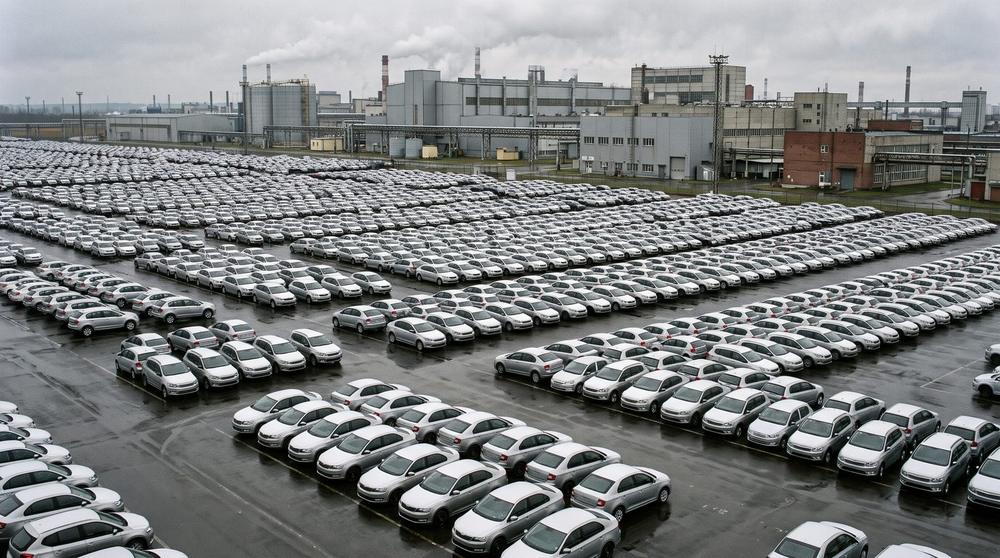
Nissan cut its global sales forecast for the second time in a matter of months on Wednesday, taking the full-year target to 2.97–3.00 million vehicles from 3.15 million. It left its full-year operating profit outlook exactly where it was: 200 billion yen.
That combination is the whole story. Volume guidance came down by roughly 150,000 to 180,000 units, blamed on weaker demand, a faster-than-expected shift to new energy vehicles and intensifying competition in China. The profit number did not move. Nissan is telling investors it will sell meaningfully fewer cars this year and earn the same from them.
The quarter behind it gives that promise a steep slope. Second-quarter operating profit was 2.1 billion yen, down from 51.5 billion a year earlier — a figure the company attributes largely to the absence of a prior-year benefit from lower US emissions-related expenses. Net revenue rose 8.2% to 3,107.8 billion yen. The net loss narrowed to 43.5 billion yen from 106.2 billion.
Our take: First-half operating profit was 80 billion yen. Holding the full-year number at 200 billion means delivering 120 billion in the second half — a 50% step up on the first half, achieved while selling fewer vehicles than the plan assumed. Management points to new models, a richer mix and momentum in Mexico and Europe, which is a coherent answer. It is also a mix-and-price answer to a volume problem, and mix-and-price answers are the ones that unravel first when a market gets more competitive rather than less. The honest read: the restructuring is working on costs, and the second half now has to carry a load the first half did not.
The cost side is holding up
First-half net revenue reached 6.072 trillion yen, up 493.3 billion year on year. First-half operating profit swung to 80.0 billion yen from a 27.7 billion loss a year earlier — an improvement of 107.7 billion — for a 1.3% operating margin. The first-half net loss narrowed to 39.7 billion yen from 221.9 billion. The Re:Nissan restructuring programme contributed 110 billion yen of additional cost savings in the half.
Put plainly: almost the entire year-on-year operating improvement is cost reduction, not commercial momentum. Global first-half sales came to 1.41 million units. Automotive net cash stood at roughly 0.8 trillion yen, with cash and equivalents of 2.2 trillion.
China is the variable
The sales downgrade is explicitly tied to China, where Nissan says it is adjusting internal combustion production and dealer inventory, accelerating its N-series NEV line-up and expanding exports of China-developed vehicles to other markets. It raised its outlook for the US and Japan, without quantifying the increase.
Chief executive Ivan Espinosa pointed to the second-half product calendar: “In the second half, we expect momentum in Mexico and new opportunities from our EV offensive in Europe.” Named launches include the Rogue Hybrid in the US, the Frontier Pro plug-in hybrid in Mexico and the Pixo EV in Europe, with a Juke EV among planned unveilings. A new business plan is due in February 2027.
What to watch
- The second-half operating profit run rate. 120 billion yen against 80 billion in the first half, on lower volume. The first quarterly print will show whether mix is actually carrying it.
- Whether the 200 billion yen holds. The volume forecast has now been cut twice. A profit target left untouched through two volume cuts is the number most likely to move next.
- Automotive net cash. At roughly 0.8 trillion yen it is the constraint on how long a product-led recovery can be funded.
- February 2027. A new business plan arriving three months from now suggests the current one is not the frame management intends to be judged on.
Figures are from Nissan’s first-half disclosures and reporting on them; China joint-venture results are on an equity accounting basis. Nothing here is investment advice.