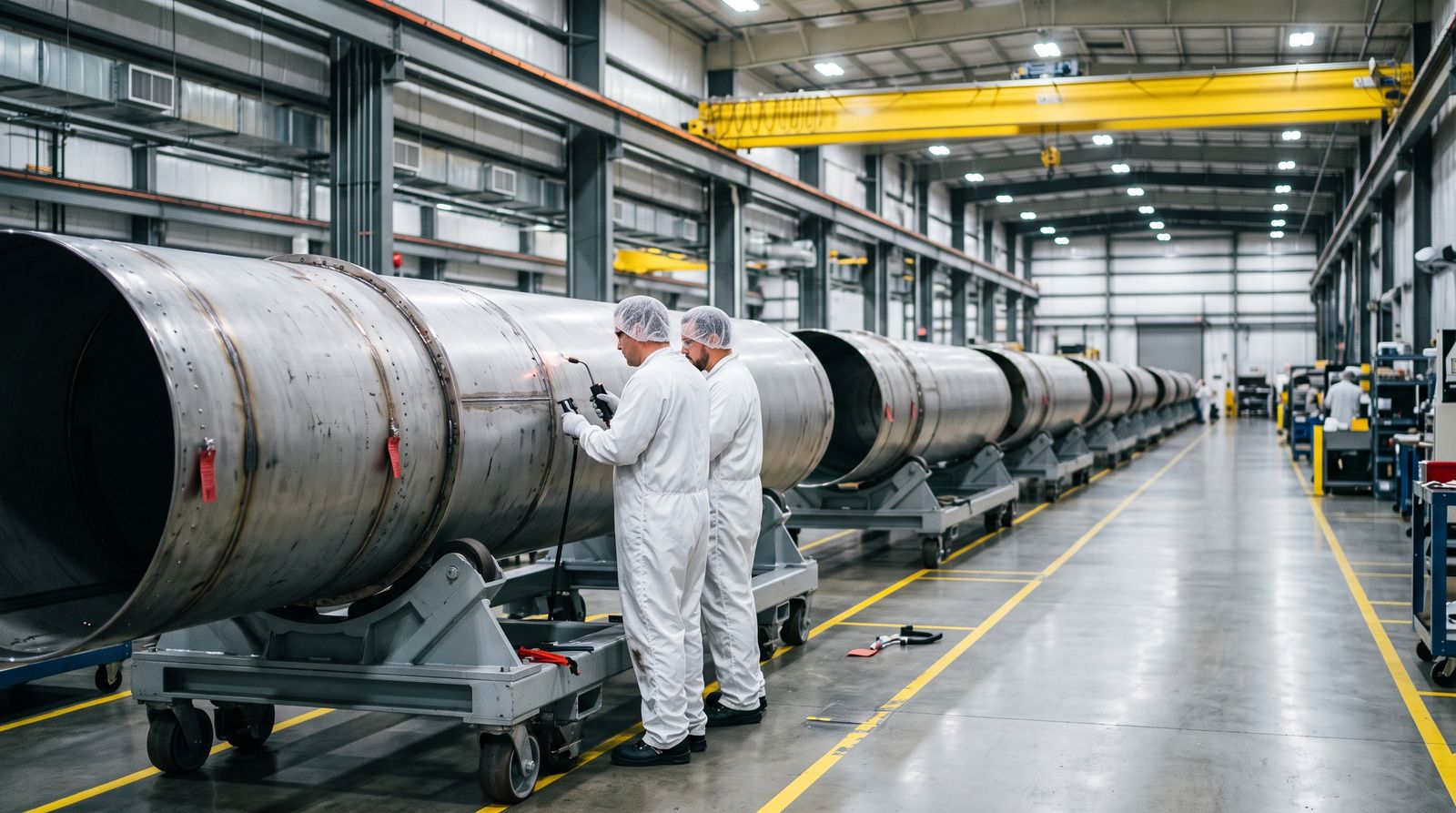
Northrop Grumman said Monday it has signed two multi-year framework agreements worth more than $3 billion, working with the U.S. Department of War and Lockheed Martin to raise output of the components inside America’s two front-line missile interceptors. Roughly $2 billion covers solid rocket motors and ignition safety devices for the PAC-3 MSE — the Patriot interceptor Lockheed builds. About $1 billion, spread over seven years, covers THAAD components, with the stated goal of quadrupling production and sharply raising monthly deliveries.
The number that matters isn’t the $3 billion. It’s 600. That is roughly how many PAC-3 MSE missiles the U.S. Army builds in a year today, and the agreement is written explicitly to push that to “thousands” for U.S. forces and allied partners. Northrop says it has doubled tactical solid-rocket-motor capacity at its Allegany Ballistics Laboratory in Rocket Center, West Virginia since 2021 and plans to triple it by 2027. It is also doubling motor capacity at its Utah facilities and adding 25% at Elkton, Maryland.
Markets treated it as confirmation rather than news. Northrop rose more than 1% in early trading and closed up about half a percent; Lockheed added 0.7% early. Both have spent the year pricing in a rearmament cycle driven by stockpiles drawn down by transfers to Ukraine and heavy interceptor use in the Middle East.
The framework is the actual product
Defense contracting normally runs on an annual clock. Congress appropriates, the Pentagon orders a quantity, the prime contractor orders parts, and a component supplier decides whether one year of demand justifies a new mixing bay, a new furnace, or 200 cleared hires. It usually doesn’t. That clock is the reason munitions surges take half a decade to show up in inventory.
A multi-year framework flips the risk. It hands the supplier a demand floor long enough to underwrite capital spending — and capital, not the contract, is the binding constraint. Solid rocket motors require energetic-materials facilities, explosive-safety siting, and a cleared workforce. None of that can be bought on a spot market during a crisis. Northrop says it has put more than $2 billion into munitions technology and facilities since 2019, over $1 billion of that into motor production, before Monday’s agreements existed. What changed is that the government is now paying for capacity it had largely been free-riding on.
Our take: The West’s air-defense problem was never the design of the missile — it was that nobody would build the factory. Interceptors get consumed at wartime rates and produced at peacetime rates, and the gap is settled by whoever happens to own spare motor capacity. What changed Monday is the contracting instrument, not the money. Three billion dollars is a rounding error against the defense budget; a seven-year floor under a supplier’s capex plan is not. Expect this structure to spread, because it is the cheapest thing the Pentagon can do about a physical bottleneck — and the first thing every allied ministry will now ask for.
What to watch
- Whether “thousands” gets a date. The ramp from roughly 600 PAC-3 MSE missiles a year is the entire story. A target without a delivery schedule is a press release.
- Allied orders. Frameworks written for “U.S. forces and allied partners” are how European and Gulf demand gets absorbed without crowding out American inventory. Foreign military sales volume is the confirmation signal.
- The labor line. Tripling motor output at Allegany by 2027 means hiring cleared workers in rural West Virginia. Capacity announcements are easy; headcount at an energetics plant is the number that actually binds.
- Follow-on frameworks. If the instrument works for interceptors, look for it next in artillery, hypersonics propulsion, and long-range strike munitions.
It fits a pattern the industrial names keep repeating: the money is moving toward whoever owns physical throughput. Boeing went to Farnborough selling production rates instead of orders. Prysmian paid $3.8 billion for steel conduit the same morning. NATO’s radar-plane award went to the vendor that could deliver. Different sectors, one bid: capacity, priced at a premium.