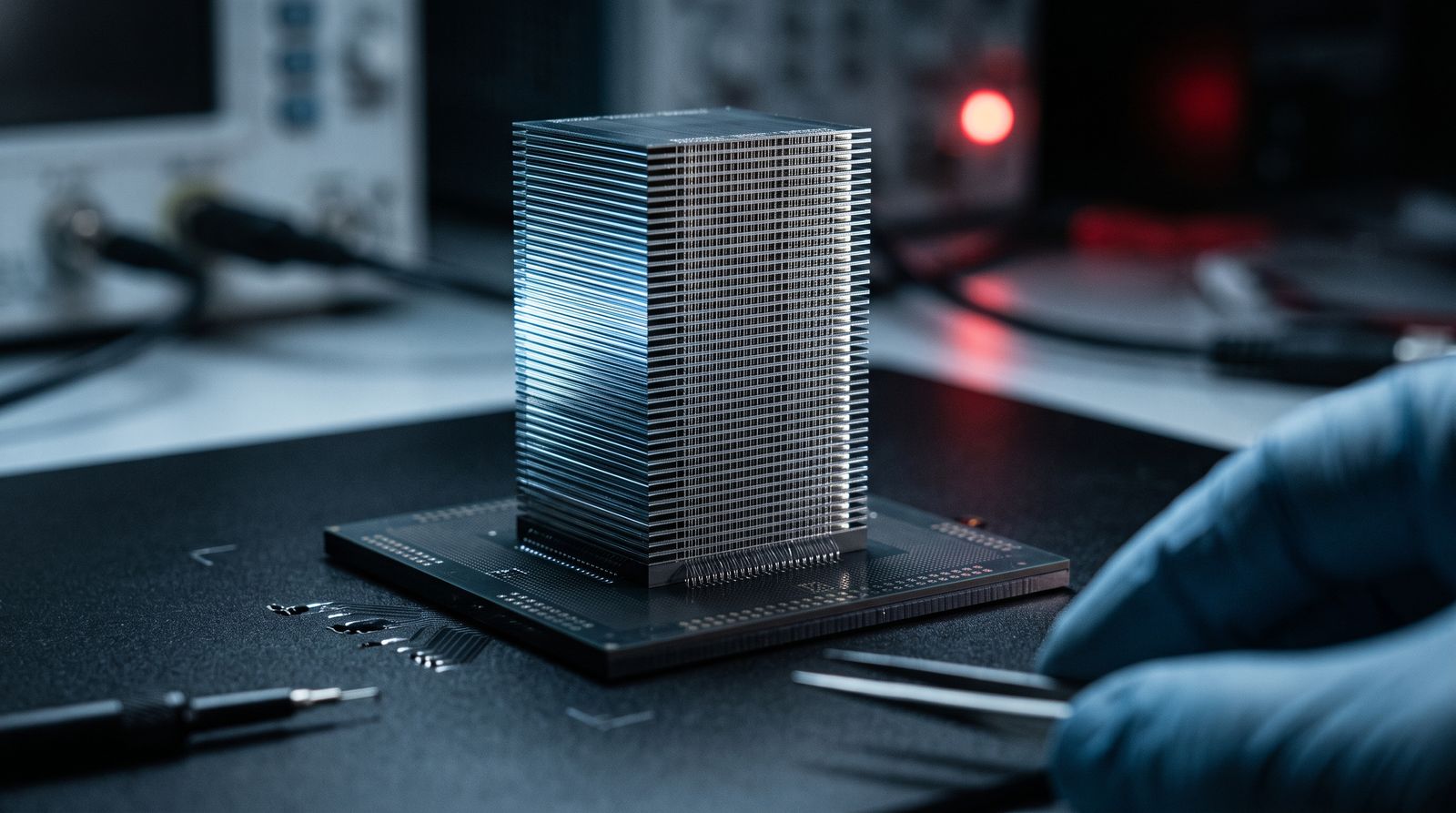
The memory shortage that has been repricing everything from data center budgets to laptops finally has an architectural answer, and Samsung put it on stage this week at the Future of Memory and Storage conference in Santa Clara. It is called zHBM, and the idea is embarrassingly simple: stop putting the memory next to the processor and start putting it on top.
Today’s high-bandwidth memory sits beside the accelerator on a shared interposer, connected by traces that are short by human standards and enormous by electrical ones. zHBM bonds the memory stack directly onto the logic die, turning millimeters into microns. Samsung’s claimed figures for an interface system built this way: about eight times the performance of HBM5, more than ten times the density, three times the energy efficiency, and thermal resistance cut by more than half. Two siblings came with it — zNAND-O, which bonds NAND onto a logic device, and V10 BV-NAND, a 400-plus-layer part roughly 58% denser than V9. All three run on the same trick: advanced wafer bonding.
Then came the part that matters more than any of those multiples. Samsung announced no production timeline for zHBM or zNAND-O, no named customer and no price. They were presented as concept models. The parts you can actually buy are already on the roadmap — HBM4E, which Samsung began sampling in May, plus HBM5, LPDDR5X-PIM and the PM1763.
Our take: The number worth arguing about isn’t the 8x. It’s the custom logic die. zHBM lets a buyer drop its own IP into the layer between memory and accelerator, which means memory and compute stop being two parts from two vendors and become one co-designed system. Excellent for whoever co-designs first; miserable for anyone who assumed they could second-source their way out of a squeeze. And read the tell: when the industry’s answer to a shortage is a concept model, the shortage is the operating plan for the next two years, not a glitch to wait out.
Why stacking is the whole game
For roughly a decade the binding constraint in AI hardware hasn’t been arithmetic — it’s been getting data to the arithmetic. Every millimeter of trace between memory and compute costs bandwidth, burns power and makes heat somebody has to remove. Vertical bonding attacks all three at once, which is why three announcements that look unrelated on a spec sheet share one technology underneath.
It also creates a new problem: bond memory to logic and the yields multiply. If either die is bad you discard both, after the expensive step rather than before it. That is the unglamorous reason these remain concepts — and why the industry keeps shipping designs that route around the constraint. One inference chip raised $312 million on the pitch that it uses neither HBM nor advanced packaging, a selling point only in a market where both are rationed.
Meanwhile the shortage those concepts would relieve runs at full throttle. AI data centers are on track to absorb roughly 70% of high-end memory output this year, up from something like 20–30% a few years ago. TrendForce tracked conventional DRAM contract prices rising 50–55% quarter over quarter earlier this year, with Counterpoint describing increases in the 80–90% range, and expects newly announced capacity not to move global supply meaningfully until 2028. The bill already reached the checkout aisle: Apple raised Mac and iPad prices this summer citing memory costs by name, and phone prices went the same direction.
What to watch
- A date. Concept to volume in memory runs years, not quarters. The first credible production window Samsung gives zHBM is when this stops being a slide.
- Who supplies the logic die. Custom IP between memory and accelerator implies a foundry partner and a design win. The first name tells you which roadmap this was built around.
- HBM4E and HBM5 cadence. That is the memory buyers can actually contract for, and the only supply that changes anyone’s 2027 budget.
- Packaging capacity, not wafer capacity. Advanced bonding is the chokepoint behind the chokepoint. New fabs don’t help if the bonding lines are full.
- Retail pricing as the honest indicator. Consumer memory prices move before any vendor admits the crunch is easing — and they haven’t eased. Anyone shopping for 2027 memory is already finding there isn’t any to buy.
The industry spent this week describing a memory architecture with no shortage. It also has no ship date. Both of those facts are the story.