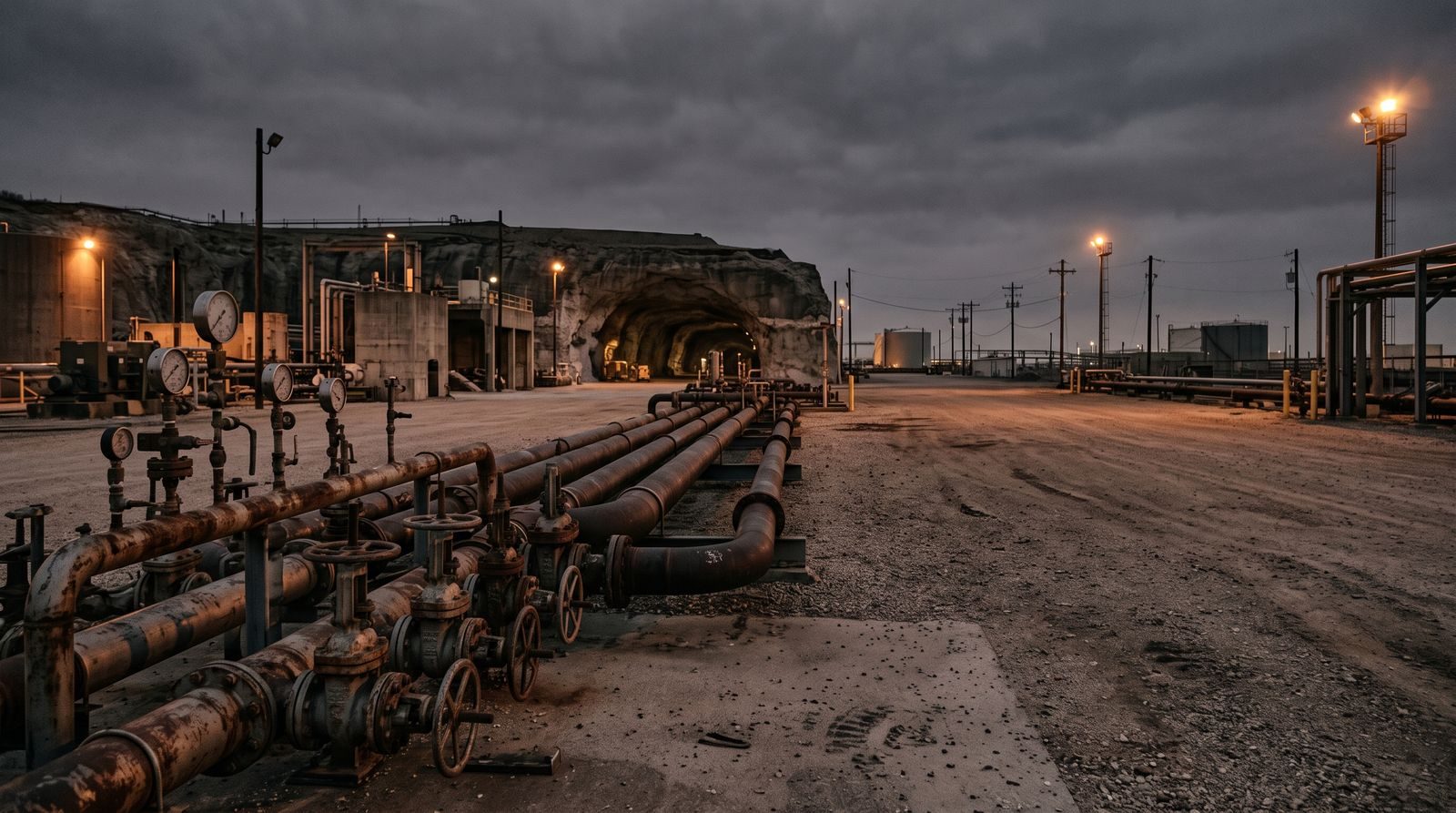
Crude stocks in the US Strategic Petroleum Reserve fell by about 5.3 million barrels last week to 293.4 million, according to Department of Energy data — the lowest level since December 1982. The reserve has now spent five months draining into a war.
The drawdown is not an accident. Trump ordered the release of 172 million barrels in March, after Iran choked off oil exports through the Strait of Hormuz, and DOE has been discharging at close to its physical maximum ever since. The policy worked in the narrow sense: it put barrels into a market that had lost them. It also means the country’s shock absorber is now thinner than at any point in the careers of most people trading oil.
The timing is the problem. Brent traded near $91 on Tuesday and US crude topped $85 after Trump said he intends to inflict more economic pain on Iran, with no sign of a Hormuz settlement. AAA put the national average for regular gasoline at $4.06 on Monday, more than 92 cents above a year ago and the highest ever recorded for mid-August. California and Hawaii are at or above $5.40. The reserve is emptiest exactly when the case for having one is loudest.
Our take: An emergency reserve is optionality, and optionality has a price. Washington sold that option in March at whatever oil cost then, and today it would have to buy it back at $91 in a market where OPEC+ has already unwound its cuts and has little spare capacity left to lend. The SPR did not fail — it did precisely what it was built for. But a buffer you have already spent is not a buffer, and the market now prices Middle East headlines against a US government with one fewer lever to pull.
Why this is a markets story, not an energy story
Because the reserve is the reason oil shocks used to be capped. When traders knew a few hundred million barrels could hit the market on a presidential signature, the tail risk in any Hormuz headline had a ceiling. That ceiling has moved up. It shows up first in the bond market: the 30-year Treasury yield rose to 5.32% on Tuesday, the highest since 2007, as a sustained oil bid feeds straight into inflation expectations. Equities followed — the Nasdaq Composite fell 1.2%, leading the S&P 500 (−0.6%) and the Dow (−0.3%) lower.
DOE has said it intends to replace roughly 200 million barrels within the next year, and it has a decent record on the mechanics: earlier exchanges came back with premiums of 24–26% in returned barrels, growing the reserve without a direct taxpayer cost. Refilling into a $91 market is a different exercise from refilling into a $60 one, and every barrel bought back is itself a bid under the price. The refill is a demand story hiding inside a supply story.
There is also a plumbing constraint that gets ignored until it doesn’t. The reserve is salt caverns and pumps built in the late 1970s. Running them at emergency discharge rates for months is not the duty cycle they were designed for, and the drawdown rate the market assumes in a crisis may not be the rate the hardware can actually deliver.
What to watch
- Weekly DOE inventory prints. The pace of decline matters more than the level. A drawdown that continues past the 172-million-barrel authorisation would signal a policy extension nobody has announced.
- The first refill solicitation. Watch the price DOE is willing to pay and the delivery window. That is the government revealing its own view of where oil settles.
- The 30-year yield. At 5.32% it is the cleanest read on whether the market thinks this oil move is a spike or a level.
- Retail earnings this week. Walmart, Target and Lowe’s report against a $4.06 pump price. Gasoline is the fastest-acting tax on discretionary spend there is.
The uncomfortable version: the US spent its emergency oil to hold prices down through a war, and prices went up anyway. What it bought was time. What it has left is less.