Tesla delivered 486,532 vehicles in the third quarter. That is 2.1% fewer than the 497,099 it delivered in the same quarter last year. The stock closed up about 5%.
Both facts are true and neither is spin. Wall Street had modelled 461,974 deliveries, so the company came in 24,558 units ahead of consensus — a wide consensus, as it happens, with Cantor Fitzgerald at 421,758 at the low end and JPMorgan at 482,000 at the high end. Tesla beat the whole range bar JPMorgan. Against expectations, it was a clean quarter. Against last year, it shrank.
The reconciliation is in the comparison, not the quarter. Q3 2025 was the quarter American buyers rushed to claim the federal EV tax credit before it expired on 30 September 2025. That pulled demand forward into a single three-month window and left an inflated base behind it. Lapping an artificial peak with a 2% decline is a different outcome from losing 2% of a normal quarter, and the year-to-date line says so: 1,324,681 vehicles through nine months, up 8.8% on the same period in 2025.
What the mix is actually saying
Model 3 and Model Y accounted for 478,237 of the deliveries. Everything else — Cybertruck, Semi, and whatever legacy Model S and X inventory remains — came to 8,295 units, down 48% year on year. Tesla is now, to a rounding error, a two-vehicle company. That is a volume strength and a product-roadmap problem at the same time.
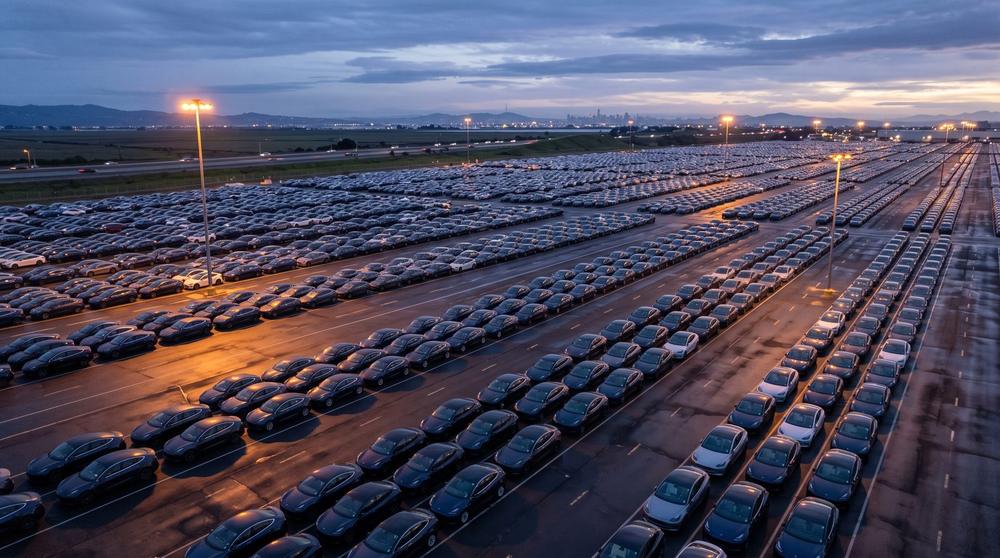
Production tells its own story: 464,391 vehicles built against 486,532 delivered, meaning Tesla shipped 22,141 more cars than it made and drew that gap out of existing inventory. Clearing stock is good for cash and good for the delivery headline. It is not repeatable, and it means the fourth quarter starts with a thinner buffer.
The energy business was the soft spot nobody led with. Storage deployments came in at 13.7 GWh, up 9.6% year on year but well short of the 15.9 GWh analysts had expected. Energy storage has been the part of Tesla that institutional investors point to when they argue the company is more than a carmaker. A miss there is a bigger deal than 2% on vehicles.
Our take: A delivery number is a volume number. It tells you nothing about what Tesla charged to move that volume. The entire question — did the company sell 486,532 cars at a price it was happy with, or did it buy the beat with incentives and financing subsidies? — is answered on 21 October, when third-quarter earnings land and automotive gross margin ex-credits becomes visible. A 5% rally on a delivery print is the market pricing a margin it has not yet seen.
What to watch
- 21 October: automotive gross margin excluding regulatory credits. That is the number the deliveries beat is implicitly forecasting.
- Inventory position: 22,141 units of drawdown means Q4 cannot run the same play twice. Watch whether production reaccelerates.
- Energy guidance: a 2.2 GWh miss against expectations, in the division that carries the non-automotive thesis.
- The rest of the sector: Rivian fell about 3% on the same day. A Tesla beat that reads as share gain rather than category growth is a narrower story than the headline suggests.
The deliveries print removed a downside risk. It did not answer the question that matters. Three more weeks.