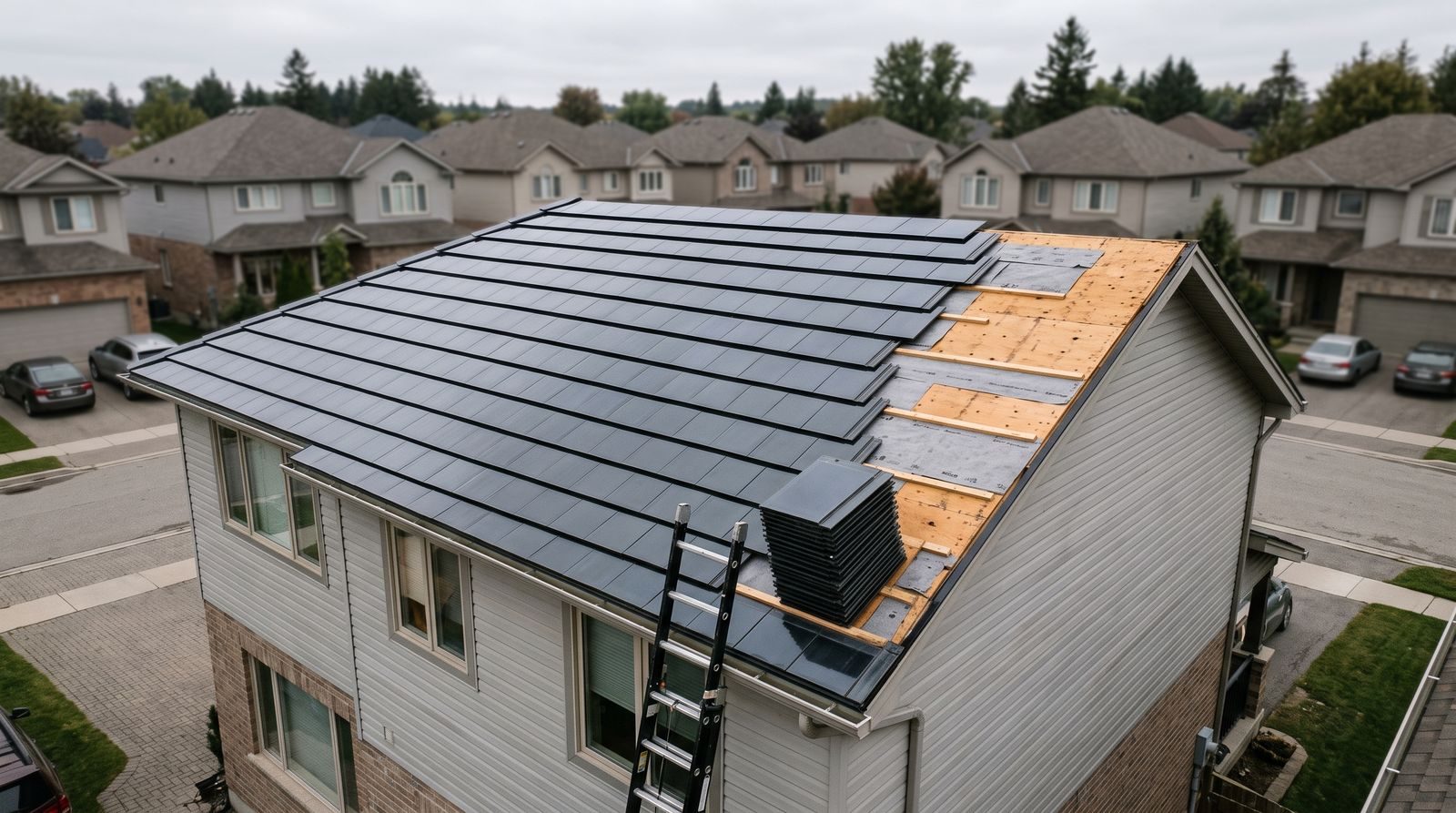
Tesla has stopped supplying its Solar Roof tiles. Two sources close to the program told Electrek, which broke the story late on 20 August, that certified third-party installers were informed the tiles are no longer available to order and that Tesla will ship only conventional panels going forward. One of those sources said the internal conclusion was blunt: the product was not financially viable.
The website backs it up, and that part is checkable by anyone. Tesla’s long-standing solarroof page now redirects to its solar panel page, the support pages redirect too, and the Energy navigation menu lists three products — Solar Panels, Powerwall, Megapack. TechCrunch independently confirmed the redirects on 21 August. Tesla has not put out a statement.
The wind-down has been visible for a while. Tesla stopped breaking out Solar Roof deployment figures in its quarterly reports in early 2024, and the product had already faded out of the marketing. Two installers told TechCrunch they can still fit one, subject to project timing — which reads like a warehouse being emptied rather than a product being sold.
The arithmetic that ended it
Elon Musk said repeatedly that Tesla would reach 1,000 Solar Roof installations a week, a target he attached first to the end of 2019 and then to the first half of 2020. Wood Mackenzie’s data puts the actual peak at roughly 21 to 32 a week. TechCrunch’s reporting has the rate at 20 to 40 a week as of 2022. Either way the gap is more than 95%.
The lifetime figure is the one worth sitting with. Wood Mackenzie estimates Tesla installed about 3,000 Solar Roof systems in the US across roughly seven years. At the promised run rate, that is three weeks of output. Seven years of a flagship product delivered less than a month of the pitch.
Pricing moved the wrong way at the same time. Early marketing put the roof near $22 per square foot and framed it as cheaper than a new roof plus panels. Installed quotes ran far above that — TechCrunch cites homeowners quoted around $200,000. In 2021 Tesla raised prices on customers who had already signed, in one reported case from about $72,000 to roughly $146,000. The class action that followed settled for $6 million in 2023.
The product existed to sell a deal
Musk unveiled the Solar Roof in October 2016 on a Hollywood back lot, using houses from the Desperate Housewives set. Weeks later, Tesla shareholders approved the roughly $2.6 billion acquisition of SolarCity — a debt-laden installer where Musk was chairman and largest shareholder, run by his cousins. The demo was a central exhibit in persuading investors to approve it. Years later, in shareholder litigation over the merger, it came out that the tiles on stage were not yet working solar products.
Our take: The failure here is not the engineering, it is the order of operations. Tesla announced a product to win a vote, then spent seven years trying to make the manufacturing and the labour model catch up to a demo. Standard panels got cheap because the world builds billions of interchangeable cells; the tiles were bespoke, so every unit of unsold volume pushed the per-unit cost of the tooling up. That is a doom loop, not a learning curve. Any product whose economics only work at a volume you have never hit is a bet on a future you do not control.
What to watch
- An official word from Tesla. As of publication there is none — only a redirect and an installer memo. How the company frames it will tell you whether inventory is still moving.
- Existing owners. Roughly 3,000 US households now own a discontinued roof. Warranty terms, replacement tile supply and service response are the real story for them.
- The category, not the company. GAF Energy and Merlin Solar are still building integrated solar roofing. Tesla exiting says something about Tesla’s cost structure; it is not a verdict on rooftop solar, where panel economics are unrelated and still improving.
- Where the energy business goes. Tesla has been leaning into standard panels plus Powerwall. Watch whether the next quarterly deck gives that line more disclosure than the Solar Roof ever got.
The concept was never silly. If you need a roof anyway, folding generation into it is a reasonable idea, and plenty of buyers wanted it. What Tesla proved is narrower and more useful: at 30 installs a week, a custom manufacturing line is a liability dressed as a moat.