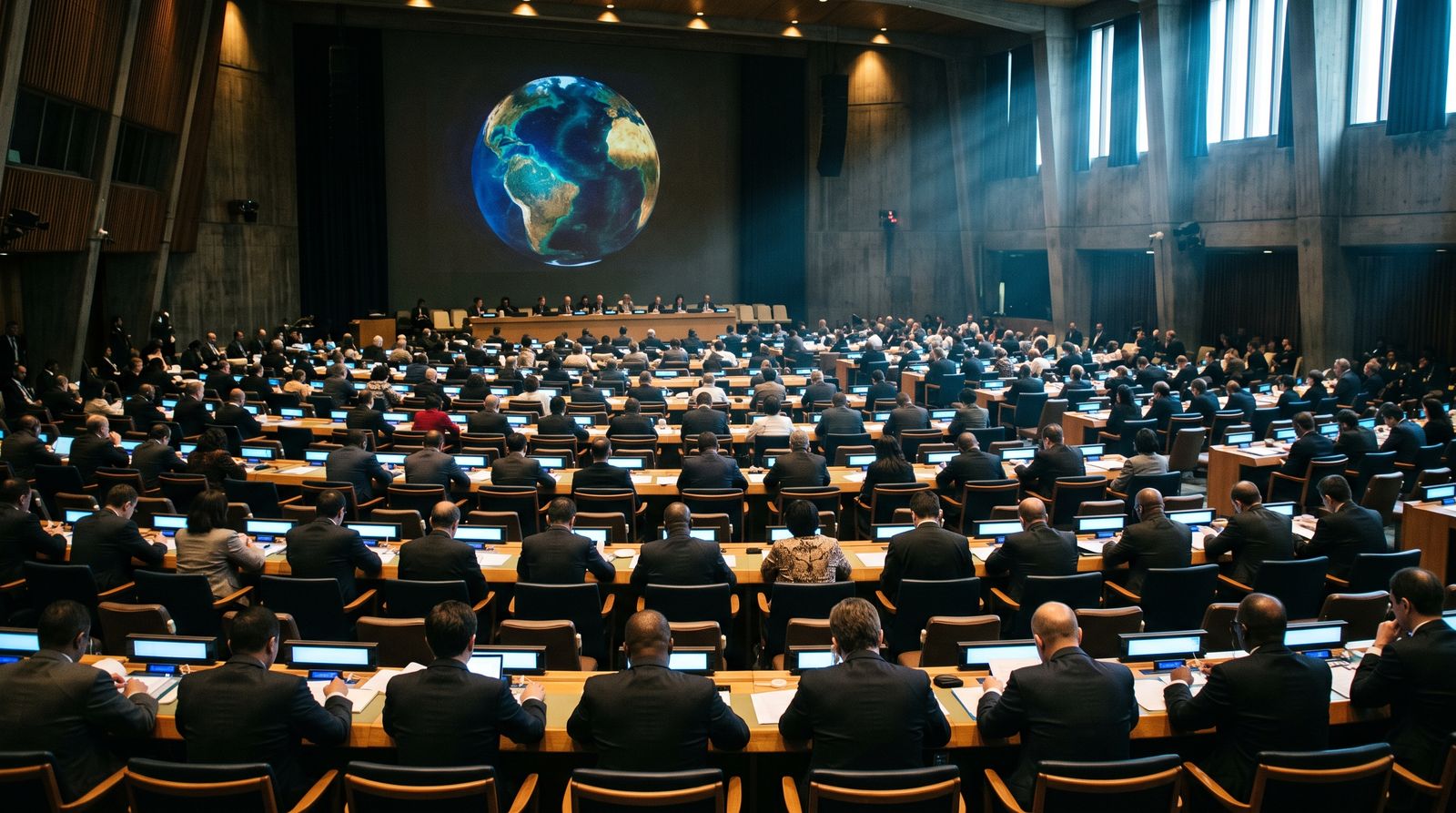
The first Global Dialogue on AI Governance opened Monday morning in Geneva with all 193 UN member states in the room — the first time every country has had a seat at an AI table. The 40-expert scientific panel formally presented the report whose bluntest finding was already public: no technical guarantee exists that the most advanced systems will follow the instructions they’re given. That part was priced in. What was new Monday was António Guterres walking to the podium with a to-do list.
The centerpiece is an AI Child Safety Pledge, announced this morning, with three rules for any system a child can reach. Prove it’s safe before shipping — child-specific safety testing plus independent oversight. Zero tolerance for machine-generated child sexual abuse imagery — detect it, report it, remove it. And never leave a child in crisis alone — when a system spots distress, it must stop and hand off to a human. “When a child is harmed,” Guterres said, “the answer must never be ‘the algorithm did it.’”
The rest of the list came fast. Recommendations for a Global Fund for AI — skills, data, and affordable compute for developing countries — head to the General Assembly shortly, with more than 20 member states already nominating centers to a UN-backed capacity network. Lethal autonomous weapons drew the sharpest language of the morning: “killer robots,” “morally repugnant,” and a demand that they be “banned by international law.” And every major AI company was asked to disclose its full carbon, water, and land footprint — and to run its data centers entirely on renewables by 2030.
The number that framed the room
Guterres put the imbalance in one line: private investment in AI infrastructure approached half a trillion dollars last year, while public investment in AI capacity for developing countries is “a rounding error.” The stakes, in his telling, compound quickly — “when power imbalances are hard-wired into technology, inequality becomes part of the code.” The internet took fifteen years to reach a billion people. AI, he noted, got there in two.
Our take: Ignore the word “voluntary” and look at the aim. The child-safety pledge lands on the same product category — companions and kid-reachable chatbots — that Beijing starts hard-regulating on July 15. When a UN ask and a Chinese law converge on one feature set in the same nine days, that’s not coincidence; that’s the compliance direction of travel. For the big labs the pledge is cheap to sign and expensive to refuse — expect signatures, then a long fight over what “independent oversight” actually means.
What to watch
- Tuesday’s close: whether any of the four asks make it into the co-chairs’ summary with dates attached. The Dialogue reconvenes in New York next year — that’s the accountability clock.
- The AI for Good Summit follows in Geneva this week. Watch for the first company signatures on the child pledge, and any takers on the 2030 renewable data-center line.
- The Global Fund recommendations landing at the General Assembly: the number attached will show whether “rounding error” was a diagnosis or a fundraising pitch.