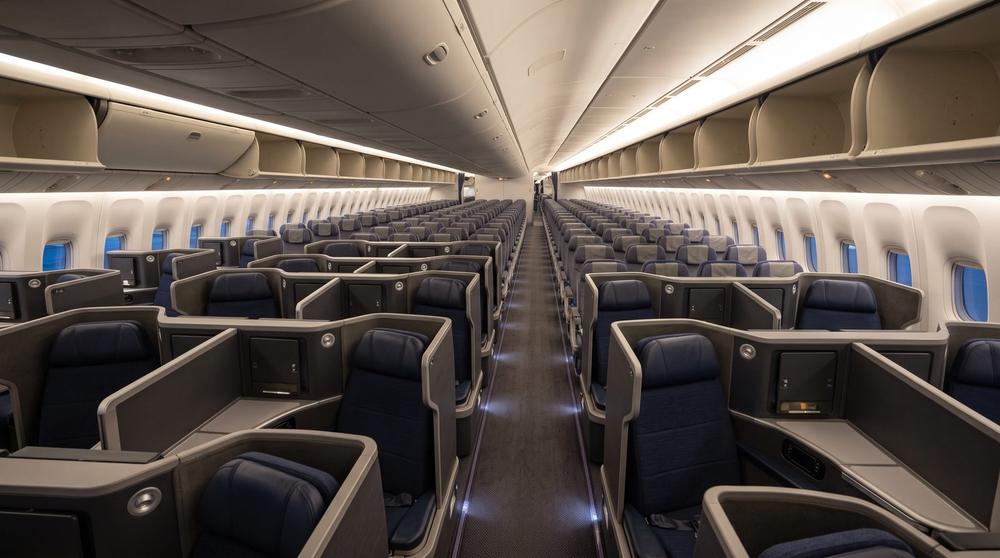
American Airlines chief executive Robert Isom said at Morgan Stanley’s Laguna conference this week that roughly 30% of the carrier’s seats produce about 50% of its revenue, and that the share of those seats will grow as aircraft are reconfigured and new deliveries arrive. Premium seating is projected to rise roughly 50% by the end of the decade.
The physical work is already visible. A 70-suite business-class cabin is flying on the 777-300ER, the airline’s largest aircraft, with more of the fleet awaiting the same treatment. The 787-8 Dreamliners are slated for a revamp and new interiors are planned for the 777-200s. Separately, American outlined a lounge investment programme that works out to roughly one new, renovated or expanded lounge per month over the next two to three years, alongside spending on disruption handling, Starlink connectivity and digital tooling.
Isom paired the premium figure with a blunter admission: the airline sells too much basic economy.
The ratio is the strategy
A 30/50 split means the average premium seat earns roughly 2.3 times the revenue of the average non-premium seat. Put the two numbers next to each other and every capital allocation decision at the airline gets easier to read. Floor space at the front is worth more than twice the floor space at the back, and floor space is the one input that genuinely cannot be expanded — the tube is the tube.
Which is why this is a reconfiguration story rather than a growth story. American is not adding aircraft to chase premium demand. It is changing the internal geometry of aircraft it already owns, converting cheap square footage into expensive square footage on assets that are already paid for. That is the highest-return capex available to a legacy carrier, and it is why every US network airline is doing a version of the same thing at the same time.
The obvious cost is on the other side of the curtain. Fewer seats sold cheaply means either higher fares in the back or fewer passengers — and on a fixed-cost asset like an aircraft, removing seats raises the break-even fare on the ones that remain. American’s bet is that premium revenue more than fills that hole. Isom’s own comment about basic economy suggests the airline thinks it has been filling seats at fares that do not earn their keep.
Our take: The 30/50 number is the most useful thing an airline executive has said publicly this year, because it converts a vague premiumisation narrative into a ratio you can hold a business against. But it also marks the point where the trade gets crowded. When four carriers all decide that the front of the plane is where the money is, they are all adding premium supply into the same corporate and high-end leisure demand pool at once, on multi-year reconfiguration timelines that cannot be reversed when demand softens. The airline that wins this is not the one that installs the most suites — it is the one that keeps its premium cabins full at list price in the first soft quarter. Watch premium load factors, not premium seat counts.
The cost side is not cooperating
The premium push is running into an input problem. Jet fuel tracks crude, and crude has been holding above $100 with the usual supply cushion absent. Refined product spreads have been worse than crude alone would suggest — the same refining-capacity squeeze that pushed diesel to six dollars sits on the jet fuel curve too.
That is the real argument for premiumisation, and it is defensive rather than opportunistic. A cabin where 30% of seats carry half the revenue is a cabin with more pricing power per unit of fuel burned. An airline that has to raise fares to cover fuel would much rather do it in a cabin whose customers are less price-elastic. Freight has spent the year demonstrating what happens when you cannot pass costs through; American is building a cabin mix designed so that it can.
What to watch
- Premium load factor, not premium seat count. Filled suites are the number; installed suites are the input.
- Basic economy mix. Isom flagged it as too high. Whether it actually falls is the test of whether this is a strategy or a talking point.
- Reconfiguration downtime. Aircraft in a hangar generate nothing. A fleet-wide retrofit is a capacity cut disguised as an upgrade.
- Competitor supply. Delta and United are expanding premium on the same routes. Aggregate premium seat growth across the industry is the variable that decides whether pricing holds.
- Fuel. Every dollar on the barrel raises the fare the back of the plane has to cover.
The ratio is real and the economics behind it are sound. The question is what happens when everyone builds the same aeroplane.