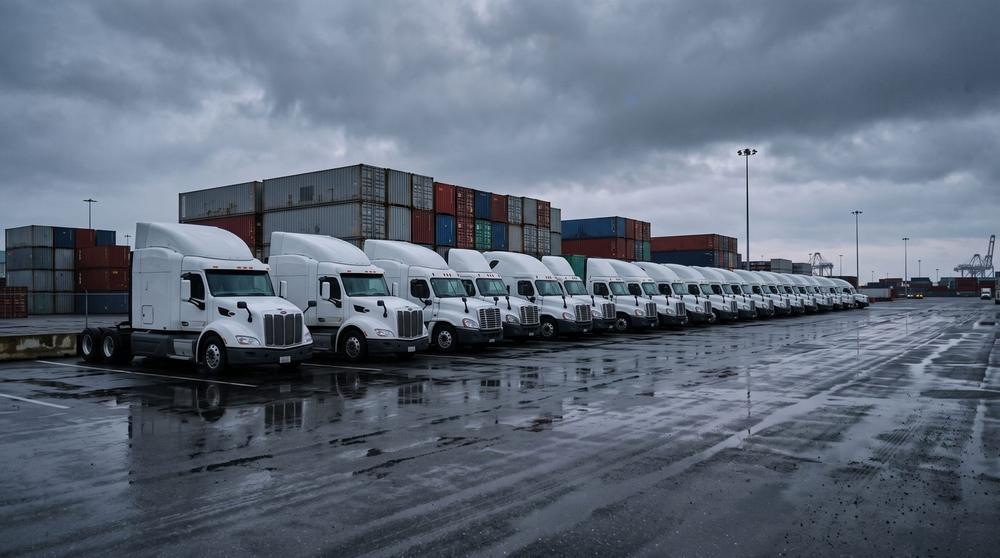
J.B. Hunt did something trucking companies almost never do: it updated the market on a quarter that was not over. Management told investors it now expects third-quarter profit to come in 5% to 10% below the second quarter, and the stock fell roughly 10–12% in Wednesday’s premarket. Old Dominion Freight Line went down about 4% alongside it.
The cause was not demand. It was cost. The company pointed at fuel — roughly $10 million of sequential expense from that line alone — and at drivers, where analysts at Barclays flagged around $25 million in higher drayage driver costs including hiring and sign-on payments. Purchased transportation had already been running hot: the Integrated Capacity Solutions segment saw that line rise 54% year over year in the second quarter.
Put next to what diesel has done, none of this is a surprise. Diesel at $6.23 is a refining story, not a crude story, which is why it has not unwound the way an oil spike normally does. What is new is the arrival: the cost shock has stopped being a commodity chart and started being guidance.
Our take: The reason this matters beyond one carrier is the direction of the pass-through. Freight contracts reprice on a lag, so a fuel and labour shock lands on the carrier’s margin first and on the shipper’s invoice second. J.B. Hunt just told you the first leg is happening now. The second leg — higher landed cost on everything that moves by truck — shows up in goods prices over the following two to three quarters, which is precisely the window the Fed is arguing about this afternoon.
Why a mid-quarter warning is the signal
Companies disclose between reporting dates when the gap between consensus and reality has grown too wide to sit on. A voluntary update that guides down 5–10% sequentially is management saying the move happened faster than the quarter could absorb. That is a different statement from a soft print in October, and the market read it that way — a 10%-plus drawdown on a guidance range, not a miss.
The read-across to Old Dominion is the part worth holding onto. ODFL runs less-than-truckload, a structurally higher-margin business with more pricing discipline than intermodal or brokerage. It fell anyway. When the highest-quality operator in the group trades down on somebody else’s cost warning, the market is repricing the input, not the company.
The inflation channel nobody models quickly
Freight is an input to almost every physical good. It also shows up with a delay long enough that it rarely features in the month’s inflation conversation. August wholesale prices had already split along exactly this line, with the headline driven heavily by one fuel while the core told a calmer story. The carrier guidance is the same shock, one step further down the chain.
If the refining constraint persists — and refining capacity does not rebuild on a quarterly clock — carriers face a choice between eating margin and raising rates into contract renewals. Historically they raise rates. That is a 2027 goods-price problem being created in September 2026.
What to watch
- Contract renewal season. Bid rounds in Q4 are where the pass-through either lands or doesn’t. Watch stated rate increases, not spot.
- Whether other carriers pre-announce. One mid-quarter warning is a company. Three is a sector.
- The diesel-to-crude spread. If it narrows, the cost shock is temporary. If it holds, it is now a structural cost line. Crude itself is still above $100.
- Driver pay. Sign-on bonuses are the tell for a labour market that has not loosened, whatever the headline jobs data says.
Note the timing. Freight cost warnings and a central bank deciding whether inflation is sticky arrived on the same morning. One of those is a forecast. The other is a company reporting what it is already paying.