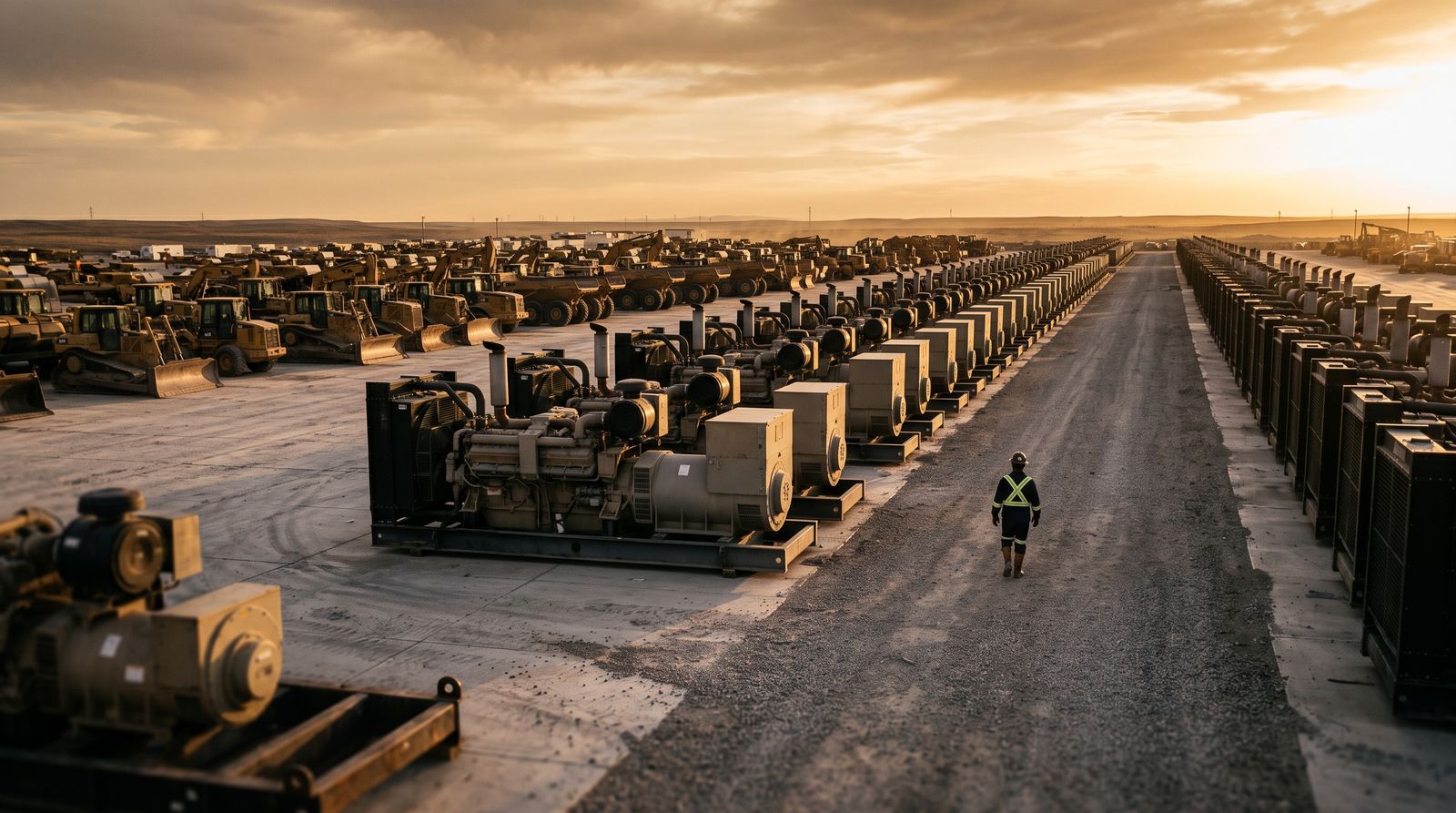
Caterpillar had never sold $20 billion of anything in three months. On Tuesday it reported $20.5 billion for the second quarter, up 24% from $16.6 billion a year ago, and the stock jumped more than 11% before the open. That is the headline. It is not the number that matters.
The number that matters is the backlog: a record $72.1 billion, up $9.4 billion from the first quarter and $34.6 billion from a year ago. Caterpillar shipped $20.5 billion in the quarter — and the order book still grew by nearly half that amount again on top. Run the arithmetic and orders landed somewhere near $30 billion, roughly $1.45 of new work booked for every dollar delivered.
The rest of the print was correspondingly loud. Adjusted profit of $8.17 per share against a $5.71 consensus — a 43% beat — on adjusted operating margin of 21.9% versus 17.6% a year ago. Operating profit up 50% to $4.3 billion. Free cash flow of $5.1 billion in the machinery business. Management raised full-year revenue growth guidance to the mid-to-high teens from low double digits, and narrowed its expected 2026 tariff bill to about $2.2 billion — the bottom of the prior $2.2–$2.6 billion range.
Our take: A record quarter is a rear-view mirror. A record backlog is a windshield. Caterpillar just disclosed that it has roughly three and a half quarters of revenue already sold, and that the order rate is still running well ahead of what the factories can ship. The risk in industrial AI names was never demand — it's that backlog converts to revenue slower than the multiple assumes. Watch conversion, not bookings.
The segment nobody was watching
Wall Street models Caterpillar as an AI-power stock, and Power & Energy delivered: sales up 17% to $8.24 billion, segment profit up 30% to $2.03 billion, margin at 24.6%, driven by turbines and large reciprocating engines heading into data centers.
Construction Industries grew twice as fast. Sales up 35% to $8.35 billion, segment profit up 57% to $1.95 billion. The unglamorous excavator-and-loader business is now larger than the data-center business, and compounding at double the rate. Resource Industries — mining — added 20% to $4.65 billion. Every one of the three primary segments is expanding, which is what CEO Joe Creed meant by "broadening momentum."
That matters because the single-story version of this trade — buy the picks and shovels of the AI buildout — is now underselling the company. Data centers need concrete, roads, trenching and site prep before they need generators. Cat sells all of it.
Two things the beat doesn't answer
First, Creed flagged softer sales to end users in the Middle East inside Construction Industries — the first visible soft patch in the fastest-growing segment, in a quarter otherwise free of them.
Second, results included $392 million of expected recoveries on IEEPA tariffs. That is real money, and it rests on a legal and policy process the company does not control. Strip it out and the quarter is still excellent; keep it in and roughly 9 cents of the adjusted number depends on a refund arriving.
What to watch
- Book-to-bill in Q3. One $9 billion backlog build is a pull-forward. Two in a row is a supercycle.
- Middle East construction. Whether Creed's soft patch stays a footnote or becomes a line item.
- The $2.2 billion tariff number. Cat narrowed it to the low end. If the number widens again, the margin story gets harder.
- Capex. About $3.5 billion planned for Machinery, Power & Energy this year — the clearest signal of whether Caterpillar believes its own backlog.
Caterpillar is the Dow's second-largest component by weight. When the company that sells the machines that build everything says its order book grew by half a quarter's revenue in ninety days, that's not a stock story. That's a read on how much physical infrastructure the AI era has actually committed to pouring.