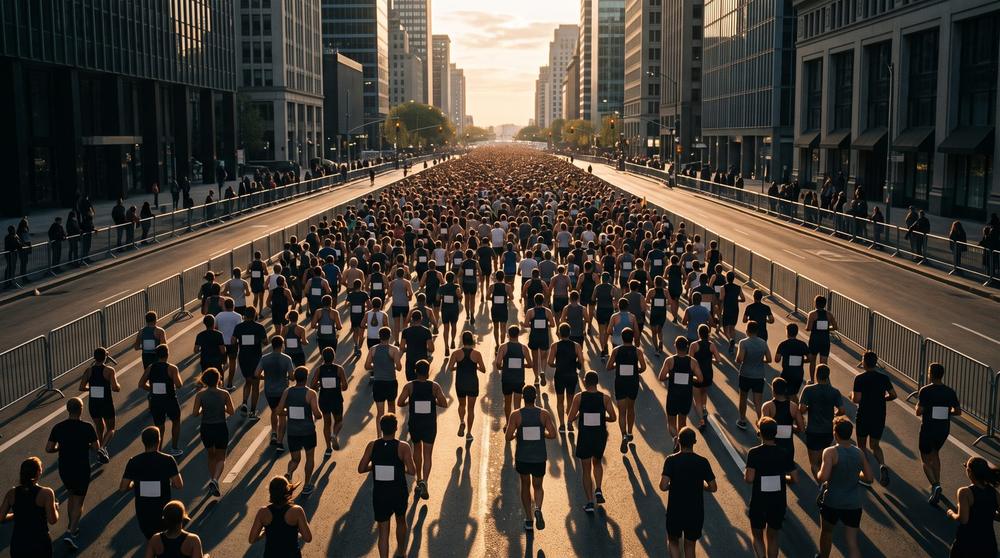
The 48th Bank of America Chicago Marathon runs on Sunday, October 11, and it will start 55,000 people — the largest field in the race’s history. Organizers say more than 200,000 applied. Round the numbers and roughly three out of four people who wanted to run Chicago this year are not running Chicago this year.
That ratio, not the field size, is the story. A lottery with a 27% hit rate is a product with a supply problem, and the Abbott World Marathon Majors have spent a decade answering that problem by adding races rather than widening the ones people actually want. Sydney joined the series last year and drew roughly 33,000 in its first year as a major. Chicago turned away more than four times that number of applicants in one cycle.
Scale also changes the race operationally. Chicago says it is the first major to put personal-hydration refill stations on the course — four of them, for runners carrying their own bottles and flasks. That is a small logistics line that tells you who the modern major field is: not 55,000 racers, but tens of thousands of people running their own private event inside somebody else’s.
The elite race is the deepest it has been
Jacob Kiplimo defends, and he arrives with the third-fastest marathon ever run. At London in April he finished third in 2:00:28 — behind Sabastian Sawe’s 1:59:30, the first sub-two-hour marathon in a legal, competitive race, and Yomif Kejelcha. Amos Kipruto, fourth in London in 2:01:39, is also entered. Milkesa Mengesha brings 2:03:17.
The American side is unusually strong: Charles Hicks ran 2:04:35 at Boston this spring, Clayton Young 2:05:41, with Galen Rupp — the 2017 Chicago winner — and CJ Albertson also on the list. Conner Mantz broke the American record here last year.
In the women’s race, defending champion Hawi Feysa returns off the 2:14:57 she ran in Chicago in 2025. Brigid Kosgei, who won here in 2019 in 2:14:04, is entered, as are Sutume Kebede (2:15:55) and the American veterans Sara Hall and Des Linden.
And the pattern that makes Chicago the most watchable date on the autumn calendar: in each of the last four years, the course has produced either a world record or an American record.
Our take: Two things are happening on the same closed streets and they have almost nothing to do with each other. At the front, a pancake-flat course and a shoe era have made Chicago a record factory — four years running, and a defending champion who has personally been inside 2:00:30. Behind that, a mass-participation event has become so oversubscribed that its primary function is rejection. Both are health signals, but only one is a business the organizers control. If you run events, a community, or any paid product: a four-to-one rejection rate is not a flex, it is unserved demand sitting in a spreadsheet. The majors have chosen prestige-by-scarcity over capacity, which is a legitimate strategy right up to the moment somebody builds the thing those 145,000 people go to instead.
What to watch
- A fifth straight year. World record or American record. The streak is the asset Chicago actually sells to broadcasters.
- Kiplimo’s first marathon since London. He ran 2:00:28 and finished third. How a runner follows a race like that — and whether 2:00:28 in April is repeatable in October — is the open question of the men’s season.
- The American record line. With Hicks at 2:04:35 and Young at 2:05:41, the US depth behind Mantz is the best it has been in a generation.
- Next year’s application window. If 200,000 applications becomes 250,000, the lottery stops being a quirk and becomes the thing the race has to fix.
Sunday will produce one time that matters at the front and 55,000 that matter to the people who ran them. The number that should interest anyone building anything is the one that does not appear in the results file: 145,000.