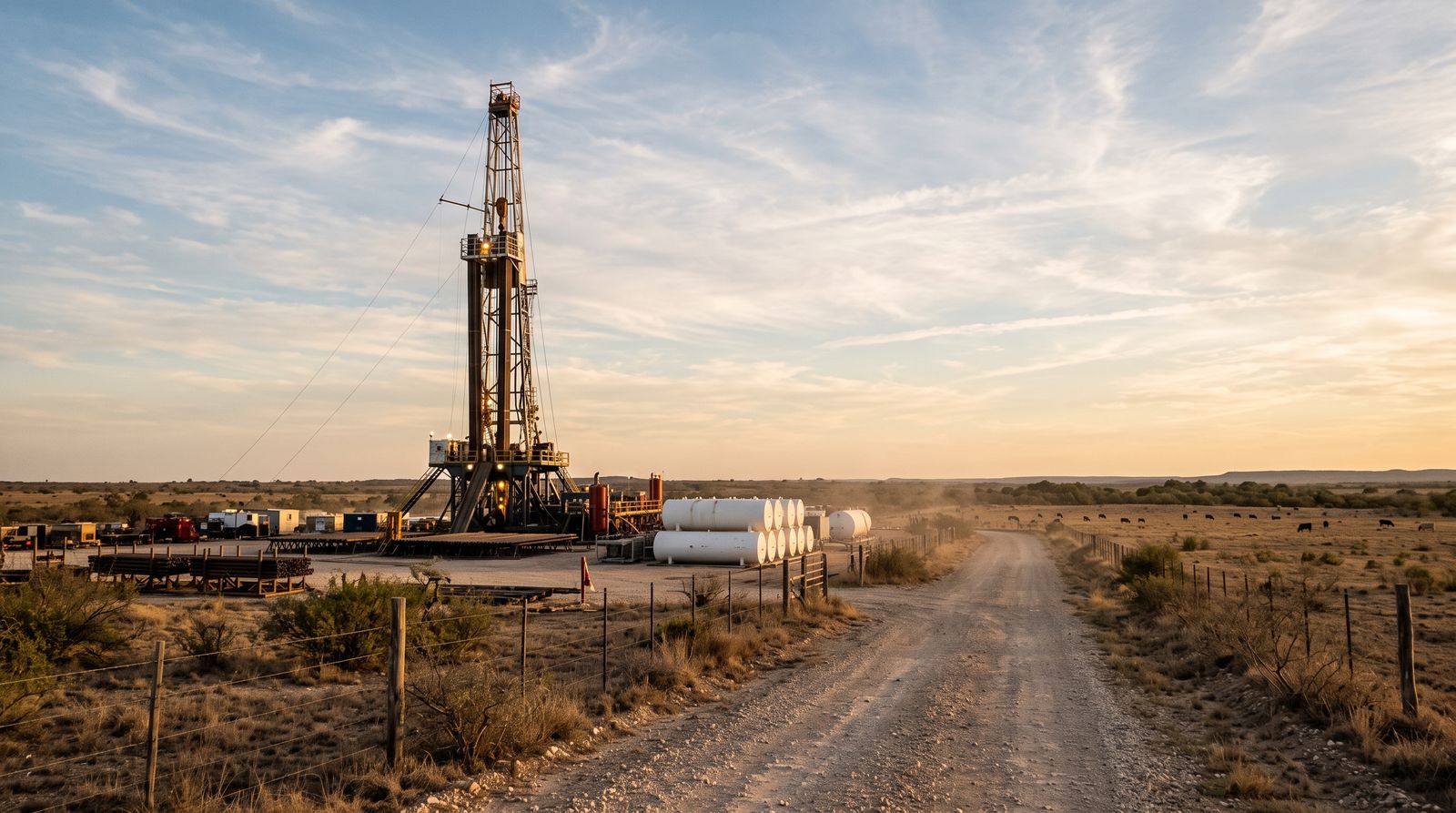
Drive northeast out of Austin to Cameron, Texas — population about 5,300 — turn down a gravel road, pass a security gate whose sign warns you about the cattle, and you reach a full-size land drilling rig that is not looking for oil.
This is the Deep Borehole Demonstration Center, built at Halliburton’s Drilling Technology Facility. Fortune published a visit to the site on Sunday. The partners — nuclear waste startup Deep Isolation Nuclear, Halliburton, Amentum, NAC International and Occlusion Nuclear Solutions — broke ground on January 28. The plan is to take the directional drilling the shale industry spent two decades perfecting and use it to place 15-foot, 5,000-pound canisters of spent nuclear fuel roughly two miles underground, in rock that has been sealed off from the surface for a million years. Then to send a crane back down and retrieve a canister, one at a time, to prove the decision is reversible.
Halliburton drills the first test well early next year. No radioactive material is used in the demonstration.
Why anyone is paying for this
More than 95,000 metric tons of spent fuel sits in temporary storage across the country, at roughly 80 sites in more than 30 states, and the pile grows by about 2,000 tons a year. Under the Nuclear Waste Policy Act, the federal government contracted to start collecting it in 1998. It never did. Utilities sued for breach of contract, the courts sided with them, and the damages come out of the Treasury’s Judgment Fund — a permanent account that sits outside normal spending caps. Roughly $10.6 billion had been paid to contract holders as of September 30, 2023. An audit conducted for the Energy Department’s inspector general put the government’s total liability at $44.5 billion.
That is the addressable market, and it explains why a company that has never disposed of a gram of waste commercially now has a public listing. Deep Isolation began trading on the OTCQB venture market under the ticker DBHL on July 13; Fortune puts its market capitalisation near $300 million. Last month the Energy Department also picked the company for three grants alongside Lawrence Berkeley National Laboratory and the University of South Carolina, studying AI-assisted screening of disposal sites under the administration’s “Genesis Mission.” The company holds 91 issued patents, and its Universal Canister System came out of a three-year project funded by ARPA-E.
The engineering is the easy part
An oil well is typically about 8 inches wide near the bottom. This one needs roughly 22 — drilled with an oversized bit, then widened with a tool called, accurately, a hole opener. The bore goes down close to a mile before bending toward horizontal at about 4 degrees every 100 feet. Halliburton North America region manager Jason Foreman told Fortune the combination of depth, deviation, hole diameter and abrasive rock is one “we’re not sure has been done before” — while also insisting that from Halliburton’s side, “it’s a well.”
The statute is harder. The Nuclear Waste Policy Act still bars permanent disposal licensing anywhere but Yucca Mountain, a repository that is, in practice, defunct. On July 28 the Energy Department signed non-binding memorandums with Utah, Tennessee, Oklahoma, Louisiana and Idaho as finalists to host “Nuclear Lifecycle Innovation Campuses,” chosen from 28 applications across 26 states, with three host states to be named by year-end. None of that touches the licensing ban. Deep Isolation CEO Rod Baltzer says the first commercial project may end up abroad — Bulgaria is among the partners in discussion — and is unlikely to be operating before the early 2030s.
Our take: The AI build-out made nuclear fashionable again — Oklo raised $1.9 billion in six months on it, and hyperscalers are now permitting their own generation rather than wait for the grid. The waste is the unpriced liability underneath every one of those gigawatts. What’s interesting at Cameron isn’t the technology — oil and gas really does this every day — it’s the arbitrage: two industries that never talked to each other, one holding a $44.5 billion problem, the other holding a 22-inch drill bit. But Deep Isolation’s real bet is that Congress moves the Yucca-only restriction before the demonstration finishes. That is a policy bet, not an engineering one, and no rig can de-risk it. Watch the well; price the statute.
What to watch
- The first test well, early next year — and specifically the retrieval. Getting a canister down is drilling. Getting it back up is the part the nuclear industry says it needs to see.
- Any move on the Nuclear Waste Policy Act. Until the Yucca-only licensing restriction changes, nothing commercial gets permitted in the United States, however well the well goes.
- DOE’s final three campus host states, due by the end of 2026 from the five named on July 28.
- Deep Isolation’s cash. A roughly $300 million OTCQB company is funding a multi-year, full-scale demonstration with no disposal revenue behind it. Baltzer says more capital is needed.