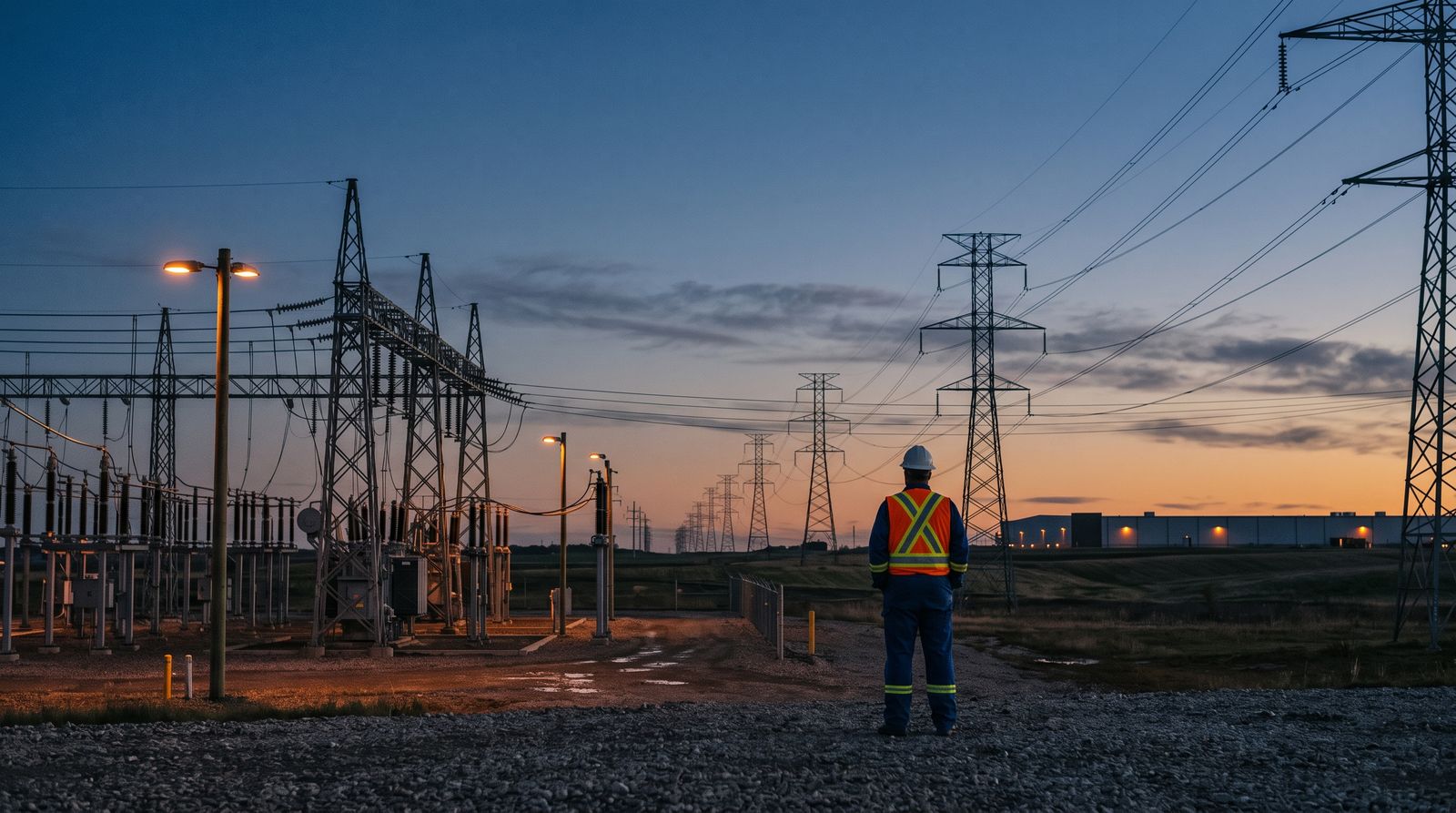
A working paper out of the Electric Power Research Institute lands against the loudest complaint in American energy politics. Researchers Asa Watten, John Bistline and Geoffrey Blanford paired Federal Energy Regulatory Commission data with Energy Information Administration retail revenue from 2015 to 2024, used an instrumental-variables approach to separate cause from correlation, and found data centers pushed retail electricity rates down.
The estimate: every doubling of data center capacity lowered average retail rates about 3.5%. At the state level, closer to 6%.
That is not what the public believes. A YouGov poll of 1,000 Americans last year found more than two-thirds expected prices to rise if a data center went up nearby. The paper says the opposite happened, for ten straight years — and it offers a mechanism rather than a vibe.
Why more demand can mean lower prices
Electricity is not priced like soybeans. Utility rates are set by cost recovery: an enormous fixed investment in generation, transmission and distribution, divided by the kilowatt-hours sold. Add a customer running a near-constant load, and those same fixed costs spread across a much larger denominator. Average prices fall. New load also pulls newer, more efficient generation onto the system, cheaper to run than what it displaces.
The paper puts data centers at roughly 4.5% of US electricity consumption in 2024, with projections of 9% to 17% by 2030. For a decade, that curve worked in the ratepayer’s favor.
Our take: This study is a division problem, and the whole fight is the denominator. Utilities are building against forecast demand, not delivered demand — McKinsey puts the buildout at $7 trillion in spending by 2030. Fixed costs hit the ratepayer the moment the steel goes up. The kilowatt-hours arrive only if the AI demand does. That gap isn’t a technology question, it’s a timing question. The paper is not a defense of the buildout. It’s a warning label written in the past tense.
The reversal is already in the auction data
Watten put it plainly to Fortune: “If the grid builds capacity, expecting a lot of demand from data centers, and that doesn’t show up, that could be a clear story of how data centers could increase prices in the future in a way that they did not do in the past.” Build the fixed costs without the customers, and “your denominator is less than you thought it would be.”
The early numbers are not reassuring. Monitoring Analytics, the independent market monitor for PJM — the largest grid operator in the country, serving 13 states and the District of Columbia — attributed $6.3 billion of the $16.4 billion in charges from the latest capacity auction to data centers, costs that reach households and businesses over the next three years. Since 2024, those auctions have added roughly $29 billion in data-center-driven costs across the region. In Virginia, the state with the most data centers, the average residential rate hit 16.01 cents per kilowatt-hour against 14.17 a year earlier — a 13% jump. Goldman Sachs projects the buildout adds 6% to electricity costs between 2026 and 2027, and another 3% by 2028.
The authors flag the supply side too: backlogged gas turbine orders, transformer shortages, tariffs raising the cost of solar, stalled federal approvals for wind. Cheap new capacity was half the reason rates fell. Capacity is no longer cheap.
What to watch
- Hyperscaler capex guidance this week. Microsoft, Meta and Amazon report Wednesday and Thursday. Those spending lines are the demand side of this equation — and bigger has stopped meaning better. Tesla and Alphabet both fell Thursday after raising AI capex.
- Load-forecast revisions. The first downward revision from a utility with a heavy interconnection queue is the denominator shrinking in public.
- Large-load tariffs. Utilities are moving data centers into their own rate class. Whether those survive challenge decides who eats a shortfall.
- Contracts versus announced gigawatts. Mark Cuban argued this week on the All-In podcast that “a lot of data centers…are going to be turned into pickleball courts.” That gap is where this settles.
For a decade, one very large customer made the grid cheaper for everyone else. Utilities are now spending on the assumption it keeps growing. If it does, the arithmetic holds. If it stalls, the same equation hands the bill to the people who were never asked.