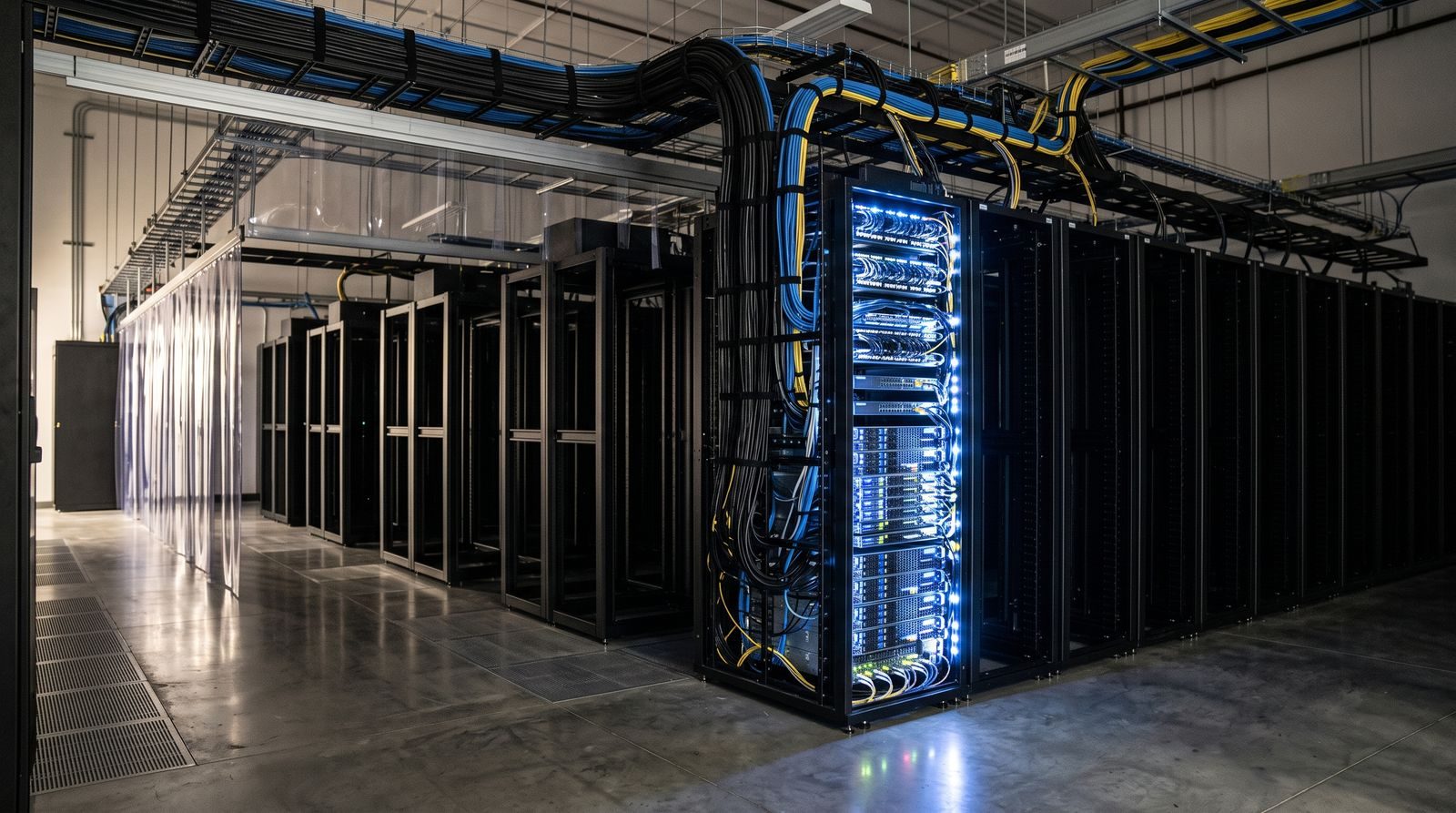
Etched said on Tuesday it has raised $700 million at a $21 billion valuation, in a round led by the quantitative trading firm Jane Street. The same announcement disclosed why Jane Street led it: the firm is Etched’s first customer, it took delivery of Etched’s first shipped rack last month, and it is now running the hardware in its own data center.
The valuation path is the part worth staring at. Etched was worth $5 billion in December. It closed a $300 million Series C at $10.3 billion on July 23. Twenty-six days later it is worth $21 billion — up roughly $11 billion in under a month, and more than four times its December mark in eight. Kleiner Perkins, Sequoia, Andreessen Horowitz, Tiger Global, Bain Capital Ventures and Blackstone all came along. Total raised to date: $1.9 billion.
All of that landed on a day when the Philadelphia Semiconductor Index fell 5.4% and shed more than $680 billion of market value in one session. Public chip investors were selling. Private ones doubled down on a three-year-old company.
Our take: The step-up is not about the round, it’s about the rack. Every AI silicon startup can show a benchmark deck; almost none can point to a paying customer with the hardware racked and in production. Jane Street tested the chip, bought it, installed it, and then led the round. That sequence — customer first, investor second — is the only diligence signal in this category that has ever meant much.
What Etched actually sells
Not a chip. Etched sells complete systems it calls “frontier inference clusters” — the same product shape Nvidia markets as AI factories. The company splits inference into its two phases and attacks each separately. Prefill — reading and understanding the prompt — is compute-bound, so Etched built a prefill chip running at low voltage, packing in more transistors inside the same power envelope without the thermal ceiling that caps conventional accelerators. Decode — generating the tokens the user actually sees — is memory-bound, so Etched built a hybrid memory and interconnect layer it calls cluster-scale memory, pooling memory across a whole cluster instead of stranding it on individual chips.
Etched has also quietly killed its own origin story. It was founded on burning one model permanently into silicon — the pitch that made it famous and made most semiconductor people roll their eyes, since a model baked into a wafer is obsolete the moment the next one ships. COO Robert Wachen told TechCrunch that is no longer how the systems work: they run any frontier model, and are already serving large mixture-of-experts and non-transformer designs.
Etched claims more than $1 billion in signed contracts across frontier AI labs and clouds. It came out of stealth on June 30 with a working chip, 400-plus people and first-pass silicon inside three years of seed funding — a schedule that essentially does not happen in semiconductors.
Why the money is chasing inference specifically
Training is a capex line you can defer. Inference is a per-query cost that scales with usage forever — the one AI expense that compounds against you. “The winners will be measured by tokens per dollar and per watt,” Kleiner Perkins managing partner Mamoon Hamid said in the announcement. Per-watt is doing real work in that sentence: power, not silicon, is rate-limiting the buildout.
That is the same thesis funding designs that skip HBM and advanced packaging entirely and pushing banks toward on-premise inference stacks. It has not been kind to everyone in the category: Groq raised at half its previous valuation earlier this cycle. Same market, opposite direction.
What to watch
- Customer two. One rack at one quant fund is a proof point, not a business. Etched says it is “sprinting on scaling production” — watch for a named frontier lab or cloud confirming a live deployment.
- Whether the $1 billion in contracts converts. Signed contracts in AI hardware routinely outrun delivered silicon by a year or more.
- Three generations in parallel. Etched says it is building three hardware generations simultaneously. That is how you keep pace with model architecture churn; it is also how young fabless companies burn $1.9 billion.
- Power draw, published. If low-voltage inference is real, tokens-per-watt settles the argument. Nobody has published it.
Nvidia is not losing this market to a $21 billion startup. But the gap between an interesting benchmark and hardware running somebody else’s production workload is where nearly every AI chip challenger has died. Etched just crossed it.