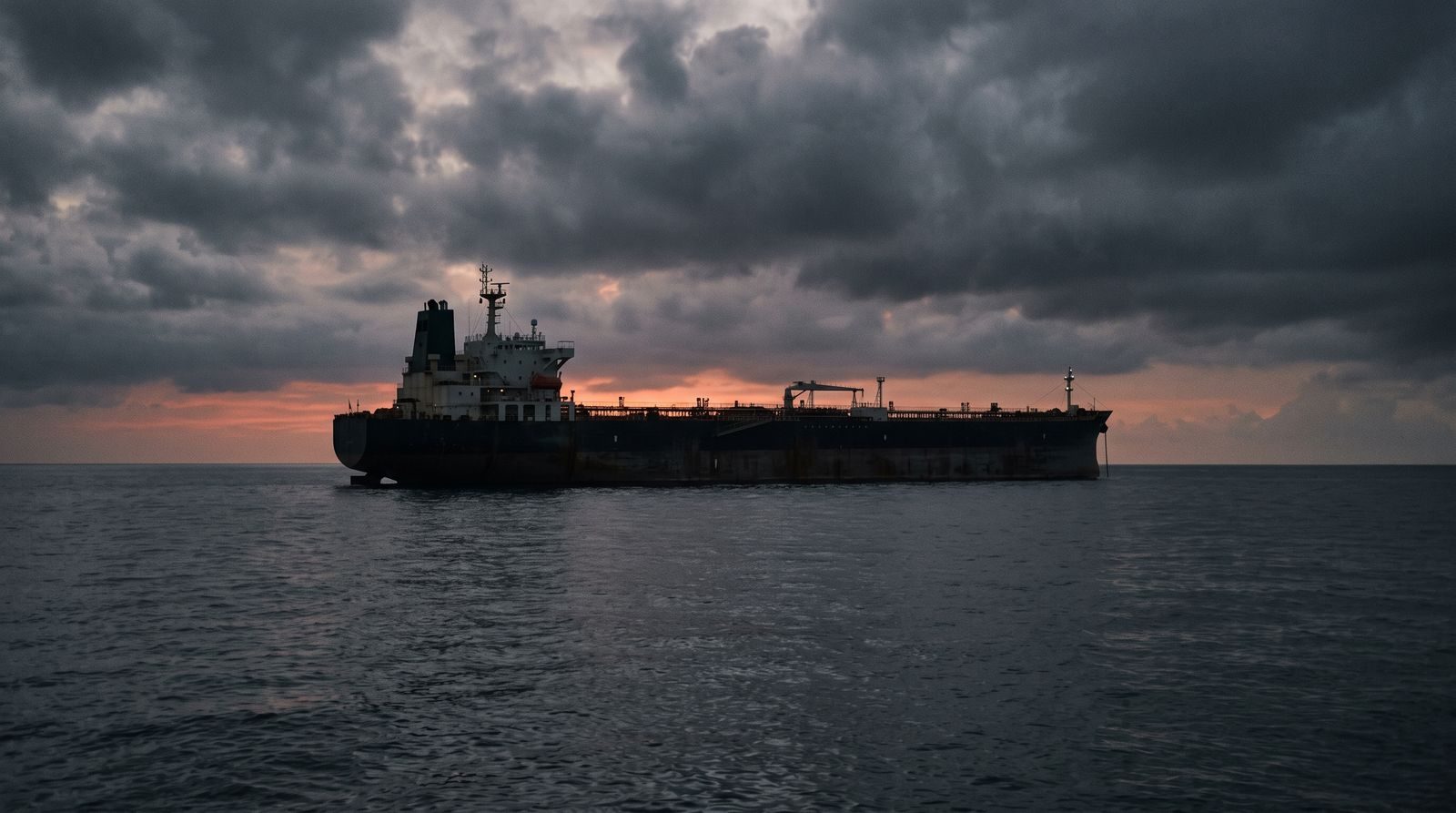
Treasury Secretary Scott Bessent said on Thursday that the United States will impose what he called “the toughest sanctions in history” on Iran, paired with a blockade, and that he will hold a press conference on Monday “to talk about exactly what we’re going to do.” He described the package as the greatest coordinated economic isolation in history and told allies they are either with the US or against it.
Oil traded the announcement in both directions. Brent touched a one-month high of $94.71 a barrel on Thursday before paring, then eased about 0.3% on Friday to roughly $93.40. US West Texas Intermediate slipped about 0.55% to roughly $86.30. Both benchmarks still finished with a second consecutive weekly gain, Brent up more than 5% on the week — even as equities closed a losing week, with the Dow up 0.98% Friday, the S&P 500 up 0.43% and the Nasdaq Composite up 0.43%.
The number that decides whether any of this works is not in Tehran. China bought more than 80% of Iran’s shipped crude in 2025, according to tanker-tracking firm Kpler. A sanctions regime aimed at Iranian barrels is, in practice, a sanctions regime aimed at Chinese refiners, Chinese banks and the shadow-fleet tankers that move the cargo.
Our take: Sanctions on a seller are easy to announce. Sanctions on the buyer are the actual policy — and that buyer is the world’s second-largest economy. The market is not pricing Monday’s press conference; it is pricing how far Washington is willing to push secondary enforcement against Chinese counterparties before something else breaks. That is a much wider distribution than a $1 move in Brent suggests.
Why the oil market is not fully convinced
Announced pressure and enforced pressure have diverged before. Iranian exports have run well above what the sanctions on paper should permit for years, routed through ship-to-ship transfers, re-flagged tankers and small independent Chinese refiners with little exposure to the dollar system. Bessent cited Venezuela and Cuba as precedents. Neither involved a buyer with China’s financial reach or its leverage in a live trade relationship with Washington.
The other constraint is domestic. The US Strategic Petroleum Reserve is at its lowest level since 1982, which means the government has thinner cover if a genuine supply disruption follows enforcement. OPEC+ has already finished unwinding its production cuts, so the spare-capacity cushion that normally absorbs a shock is smaller than the headline barrel count implies.
What to watch
- Monday’s specifics. Whether the package names Chinese entities directly, or stays with Iranian-flagged vessels and Iranian institutions. The first is a market event; the second is a headline.
- Secondary-sanctions language. Any mention of correspondent banking access for institutions handling Iranian oil payments is the sharpest instrument in the toolkit — and the one most likely to draw retaliation.
- Kpler and TankerTrackers export data. Loadings and floating storage in the two to four weeks after enforcement will tell you what the policy actually did, well before official statistics do.
- Brent’s prompt spread. Backwardation widening is the market saying physical barrels are getting scarce. Flat prices can move on rhetoric; the curve is harder to talk up.
- Jackson Hole. The Fed’s symposium lands in the same week. An energy-driven inflation impulse arriving while the long end is already unstable is the combination that has been hurting equities all month.
The setup into Monday is a market that has already paid up twice in two weeks for supply risk it cannot yet size. If the package lands narrower than the rhetoric, the war premium comes back out fast. If it names Chinese buyers, the question stops being about oil.