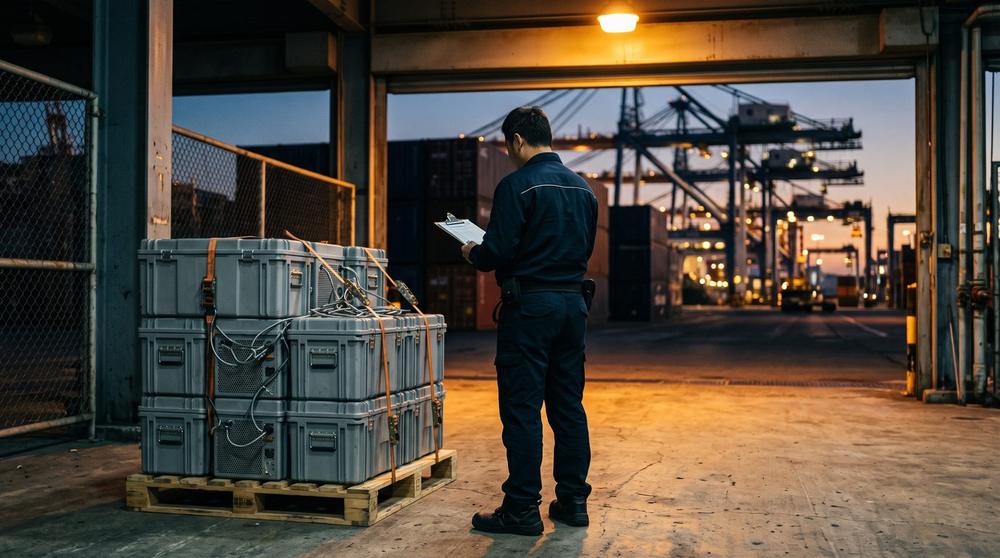
Taiwan is moving the smuggling of AI hardware out of the customs-paperwork column and into the criminal code. Economic Affairs Minister Kung Ming-hsin said advanced AI servers and cutting-edge semiconductors will be added to the island’s controlled commodities list, and a draft amendment to the Foreign Trade Act from DPP legislator Chung Chia-pin would create a direct criminal charge for routing that hardware into China.
The structural change matters more than the headline. Taiwan’s existing regime is a name-based blacklist: Huawei and SMIC have been designated strategic high-tech commodities since mid-2025, and everything turned on whether the buyer on the invoice was one of them. The replacement is a category restriction covering Chinese buyers generally. You no longer evade it by shipping to a name nobody has written down yet.
Neither piece is law yet. No effective date has been published, and the amendment still has to clear the legislature.
Our take: This closes an enforcement gap Taiwan has been embarrassed by in public. When prosecutors moved against Super Micro staff in Taiwan this July over chip diversion, the charge they reached for was forgery — because the export statute had no criminal mechanism for the conduct itself. That is the tell. For three years the binding constraint on AI chip controls has not been the rules, it has been the absence of anything that happens to you for breaking them. A diversion that costs you a revoked licence is a business expense; one that costs you a prison sentence is a different calculation, and it is priced into the broker’s fee rather than the chip.
Why Taiwan, and why now
The timing follows January’s trade agreement with Washington, which cut US tariffs on most Taiwanese goods from 20% to 15% in exchange for roughly $250 billion of pledged Taiwanese investment in US semiconductor, energy and AI projects, with TSMC at the centre of it. Export discipline was always the implicit other half of that bargain. Washington can restrict what American firms sell; it cannot restrict what leaves Taoyuan unless Taiwan does.
Taiwan has already been here in court: prosecutors brought indictments over diverted Nvidia B300 hardware earlier this year. Taiwan also has its own reason. Every diverted rack that turns up in a Chinese data centre is an argument for tightening controls on Taiwan itself — on the fabs, the packaging capacity and the export licences that are the island’s main source of leverage. Policing the back door is cheaper than having someone else police the front one.
Who actually feels it
Not the chipmakers, directly. Nvidia and AMD are already barred by US rules from selling their top parts into China; the grey market exists precisely because that demand has nowhere legal to go. The people exposed here are the intermediaries — the Taiwanese integrators, freight forwarders and resellers who assemble servers, re-label them and move them through Southeast Asia. Our earlier reporting on a $300 million server-smuggling case showed how little of that work is technical and how much of it is documentation.
Expect the immediate effect to be procedural: more end-user certification, slower shipments to anywhere with a history of re-export, and compliance staff at mid-size Taiwanese integrators who suddenly have veto power over a sale.
What to watch
- The penalty schedule. The draft creates a criminal charge; the sentencing range is what determines whether it changes behaviour. A fine is a cost. A custodial term is a deterrent.
- How “Chinese buyer” is defined. Category rules live or die on their definition of control. If it stops at direct ownership, Singapore and Malaysia remain the route.
- Whether the list captures servers or only chips. Kung named both. Full racks are the unit that actually moves; a chips-only list would miss most of the trade.
- Legislative calendar. Until the amendment passes and the commodity list updates, nothing has changed except the warning.