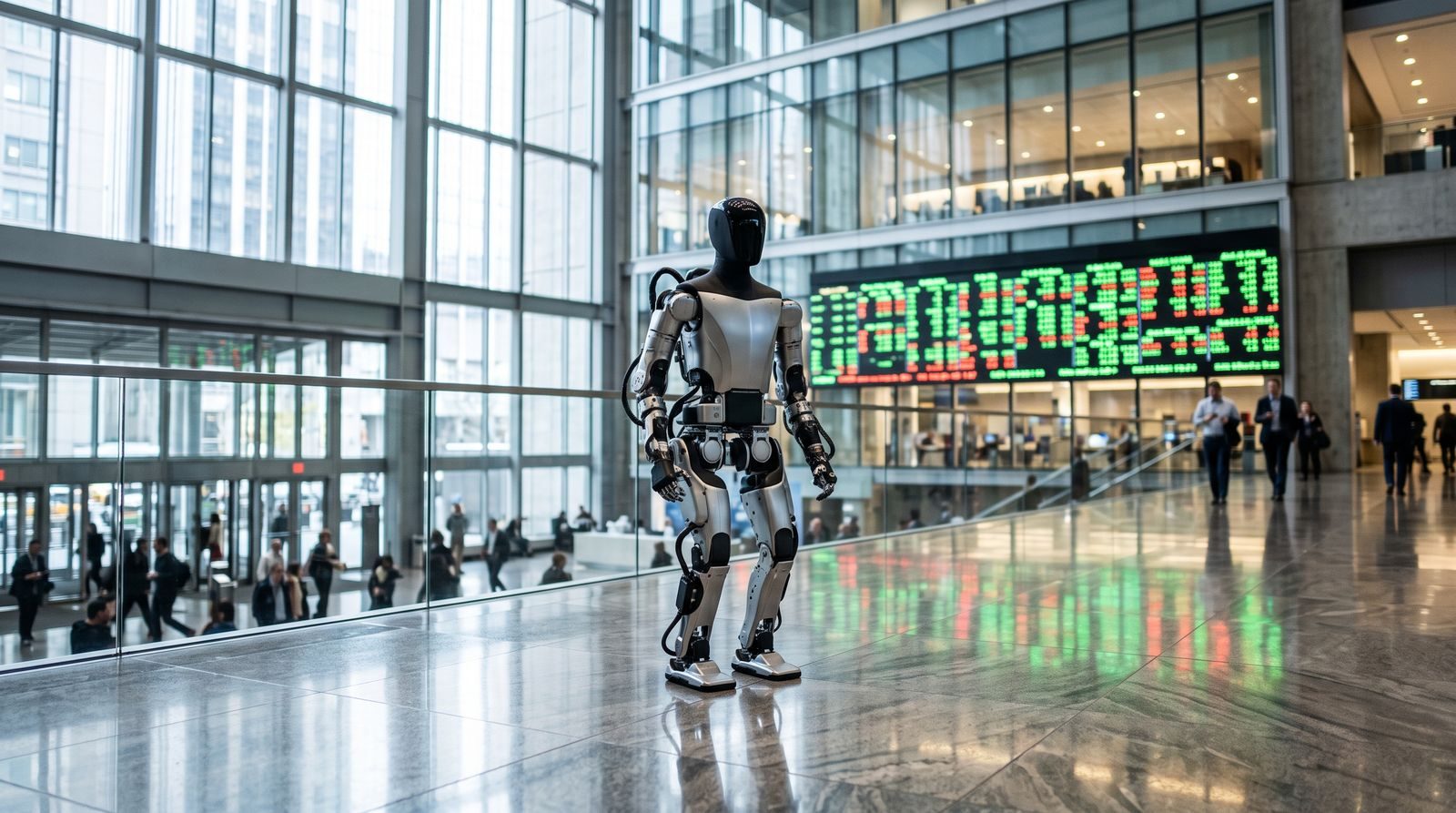
Unitree Robotics began trading on the Shanghai Stock Exchange’s STAR Market on Wednesday, and the opening print was 1,100 yuan against an IPO price of 150.80 — a 629% gain before a single minute of ordinary trading had happened. That opening tick valued the Hangzhou humanoid maker at roughly 445 billion yuan, about US$66 billion.
It did not hold. The stock gave back a large slice of the pop and closed at 845 yuan, up 460% on the day, for a market capitalisation of about 342 billion yuan — roughly $50 billion. The offering itself raised about 6.1 billion yuan ($904 million) for 40.45 million new shares, a tenth of the company. Unitree is now the first humanoid robot maker listed on the mainland.
The demand was never in doubt. As we noted when the book opened, retail investors bid for 5,526 times the shares on offer. On the day, roughly 9.8 million retail accounts chased about 9.7 million shares — more accounts than shares. Meituan, the largest outside shareholder at 8.7% post-issue, ended the session sitting on close to 30 billion yuan, about 70 times what it put in.
The number the close is asking you to believe
Unitree booked 1.70 billion yuan of revenue in 2025. At Wednesday’s close, the market is paying about 201 times that. At the opening print it was 262 times. Net profit was 278.21 million yuan, which puts the closing price somewhere north of 1,200 times trailing earnings.
For scale: the IPO itself was priced at about 61 billion yuan, or roughly 36 times sales. That was already a rich number for a hardware company. One trading session multiplied it by five and a half.
What is actually underneath it
More than the multiple suggests, which is the honest part of this story. Revenue went 159 million yuan in 2023, to 393 million in 2024, to 1.70 billion in 2025 — a 4.3x year. Humanoids went from 1.9% of core revenue in 2023 to 51.5% in 2025, on shipments above 5,500 units. Gross margin improved to near 60% while the average humanoid selling price fell to about 166,400 yuan. Falling price, rising margin, volume up several fold: that is a manufacturer moving down a cost curve, not a science project.
It is also, unlike most of the sector, profitable. That is genuinely rare here. Compare the state of the art on capability — Google’s own published charts show its best robotics model screwing in a light bulb 36% of the time. The machines are not general-purpose yet. Unitree sells them anyway, mostly to research labs, universities, entertainment and industrial buyers.
The exposure worth naming: 731.66 million yuan of 2025 revenue — 43.65% of the main business — came from overseas. Nearly half the top line sits on the wrong side of an export relationship that has been narrowing for two years, and Unitree is not the only Chinese firm pushing hardware into foreign markets while that window is open.
Our take: Two things are true at once. Unitree is a real company with real units shipped, real margin expansion and real profit — which makes it a genuine outlier in humanoids. And 201 times sales prices in an addressable market that does not exist yet. The close is not a verdict on Unitree’s engineering; it is a verdict on scarcity. There is exactly one listed way to own mainland humanoids, 9.8 million accounts wanted it, and only 10% of the company was for sale. Scarcity premiums are real, and they are also the first thing to go when the second and third listings arrive.
What to watch
- The next comparable listing. The moment a second mainland humanoid maker floats, the scarcity half of this multiple gets tested directly.
- Whether unit economics hold as price falls. ASP down to 166,400 yuan with gross margin near 60% is the whole bull case. If the next price cut takes margin with it, the cost curve story breaks.
- The overseas 43.65%. Any tightening of export or procurement rules in the US or Europe hits close to half of main-business revenue.
- Lock-up expiries. Only 10% of shares floated. Meituan’s 8.7% and the pre-IPO base are the supply that has not met this price yet.
- Whether “Superman” ships. Unitree unveiled the new humanoid on Monday, claiming a two-metre standing jump and 12.66 m/s. Specifications are a demo. Shipments are a business.