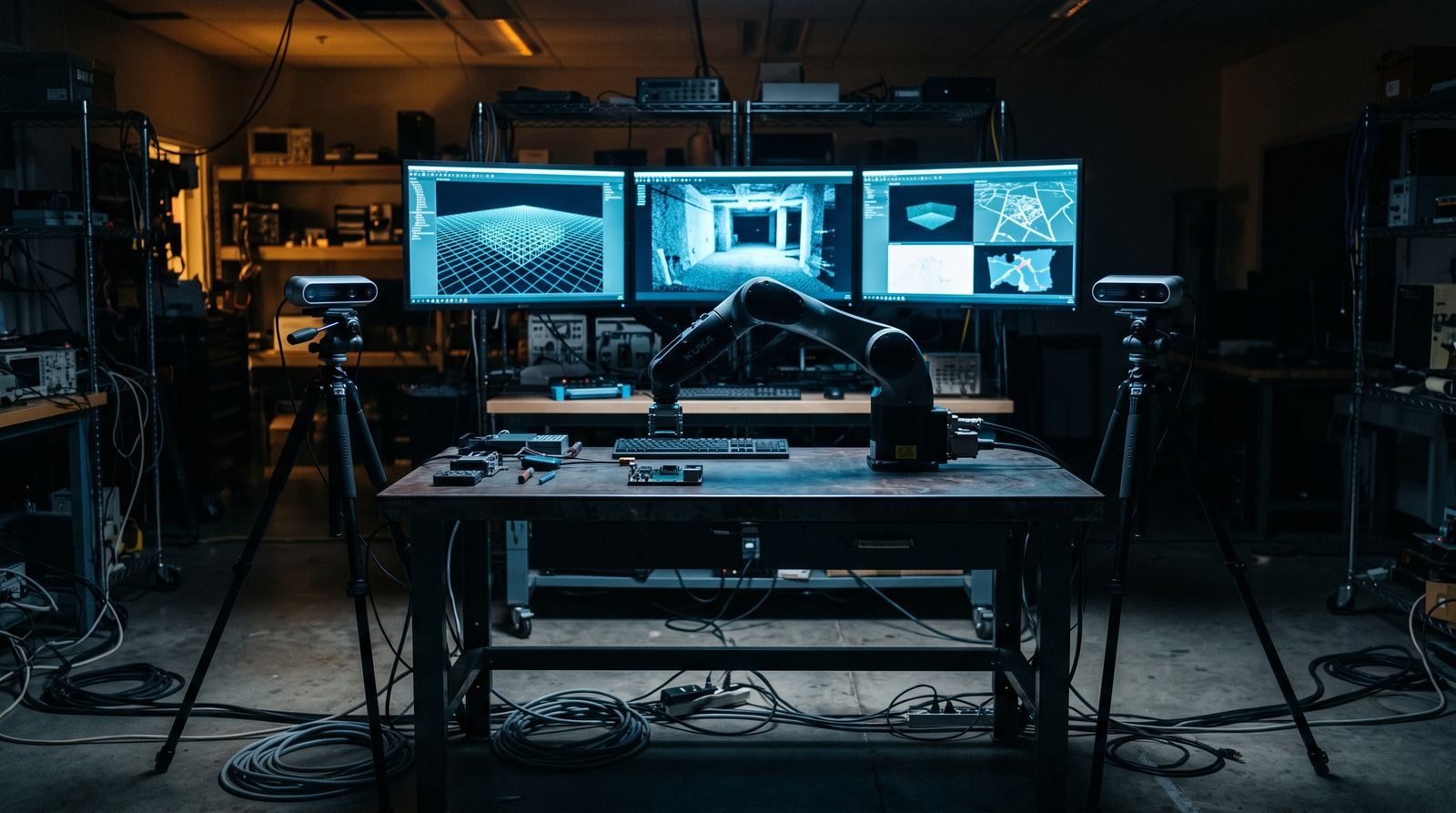
Veeda AI came out of stealth on Wednesday with $90 million of seed funding co-led by Khosla Ventures and Radical Ventures. The company was incorporated roughly three months ago. It has no shipping product and no disclosed customers. It is, by several counts, one of the largest seed rounds ever raised by a Canadian startup.
The founders explain the price. Sanja Fidler joined Nvidia in 2018 to stand up its Toronto research group, which grew into the company’s Spatial Intelligence Lab and became a vice-president-level post. She brought two Nvidia colleagues with her: Huan Ling as chief scientist and Zan Gojcic as CTO. Between them they worked on Nvidia’s first world models for physical-AI developers — the simulation stack that sits underneath a good deal of the robotics industry’s training pipeline.
Veeda is now building a competing version of that, independently. Fidler described the mission on LinkedIn as building “simulated reality for Physical AI,” and made the constraint explicit: robots cannot learn by trial and error in the real world, because robot hardware doesn’t scale the way compute does. You cannot run a million parallel copies of a warehouse arm. You can run a million parallel copies of a simulated one.
Why the simulator is the scarce asset
Every embodied-AI company faces the same arithmetic. A language model trains on text that already exists and cost nothing to produce. A robot policy trains on physical interaction data that has to be generated one attempt at a time, on hardware that breaks, in environments that have to be built. That is the bottleneck — not the motors, not the chips.
World models are the proposed way around it: a multimodal model that simulates physics, geometry and motion well enough that a policy trained inside it survives contact with a real floor. Get that right and data stops being a supply problem and becomes a compute problem. Which is exactly the trade the AI industry has spent three years proving it knows how to make.
Our take: The $90 million is not a bet on Veeda’s product, because there isn’t one. It’s a bet that the number of people who have actually shipped a production world model is small enough to count, and that three of them just became available at the same time. In a market this early, hiring is the moat — and the seed round is a hiring budget.
The same two firms keep showing up
Khosla and Radical are not making a first foray here. The pair co-led the seed round of former Google chief scientist Jeff Dean’s startup Discovery Loop earlier this month. Khosla co-led autonomous-trucking company Waabi’s $750 million Series C in January — billed at the time as the largest fundraise in Canadian history, at a valuation reported near $3 billion — with Radical participating. Radical has also backed Fei-Fei Li’s World Labs, which closed a $1 billion round in February at a valuation reported around $5 billion, and Decart, which raised $300 million in May.
That is four world-model companies with overlapping backers, and it tells you how the category is being underwritten: not as a race to one winner, but as a portfolio bet that simulation becomes an infrastructure layer somebody has to own. Nvidia, whose Cosmos models occupy that position today, is now competing with the people who built them.
What to watch
- A benchmark, or the absence of one. World models have no agreed sim-to-real metric. Whoever publishes a credible one shapes the category — and the labs with the weakest models will argue the metric is wrong.
- Whether Veeda sells to robot makers or competes with them. Infrastructure and application are very different businesses, and the seed deck rarely settles which one you end up in.
- Nvidia’s response. Cosmos is free and bundled with the hardware. A startup charging for simulation has to be materially better, not marginally.
- Talent flow out of the big labs. Fidler is the second senior figure in a month to leave a frontier employer and raise nine figures at seed. That pattern is a leading indicator of where the next capital cycle goes.
The unglamorous version of this story: robotics has spent a decade short of data, and investors have decided the fix is worth funding before anyone can demo it.