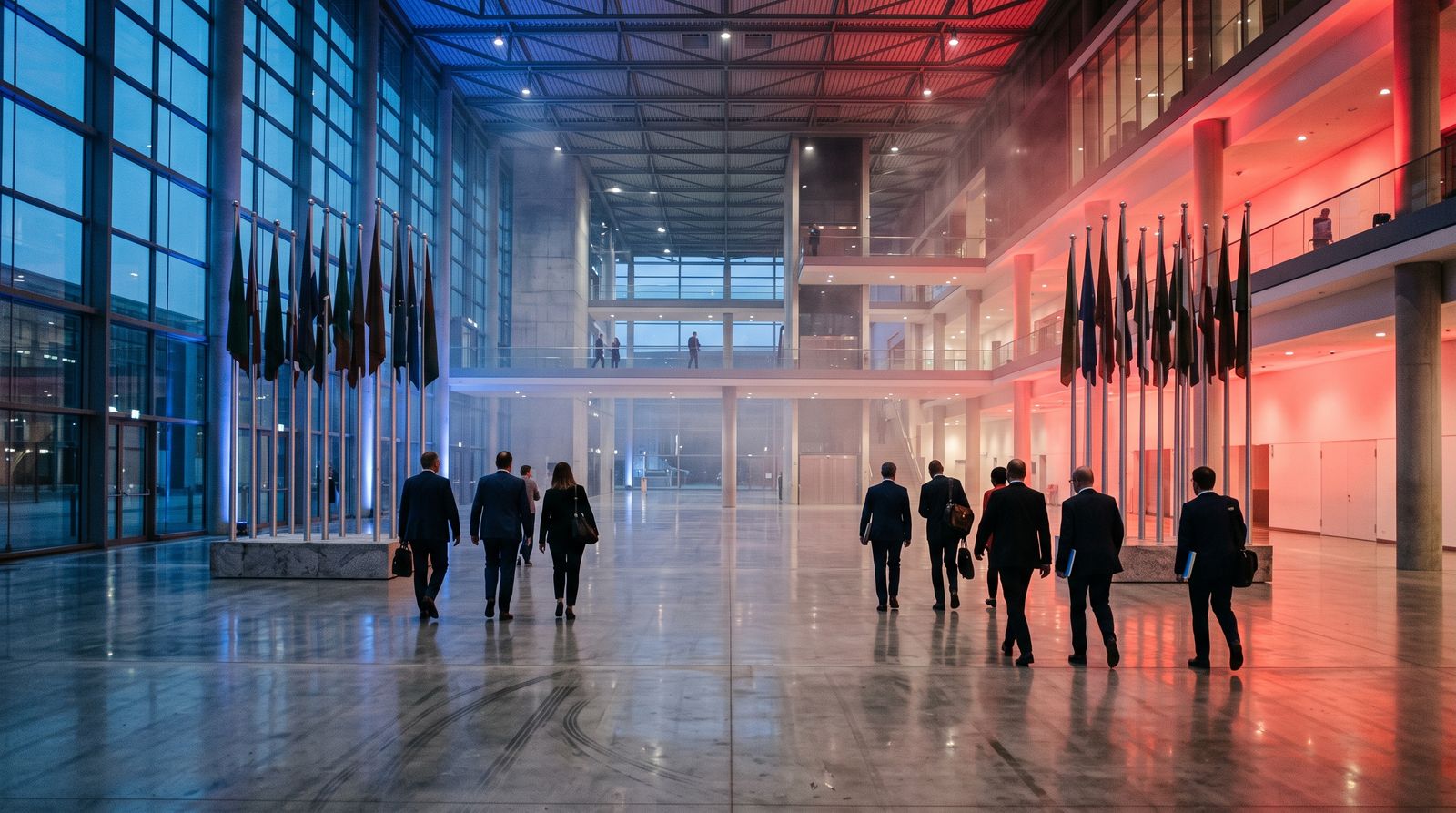
The ninth World Artificial Intelligence Conference closed in Shanghai on Monday — the biggest in its history, with more than 1,100 companies, 3,000-plus exhibits and over 300 global product debuts. The closing ceremony was set to deliver a governance communiqué and the SAIL Award, WAIC’s flagship prize. But the thing that will outlast every demo on the floor was signed before the conference even opened: a founding agreement that gives the world two competing AI rulebooks.
On July 16, representatives of 29 nations — Russia, Indonesia, Pakistan, Brazil and ten African states among them — created the World Artificial Intelligence Cooperation Organization, headquartered in Shanghai and open to any sovereign state, no values test required. Not one G7 economy signed. Neither did any EU member, Australia or South Korea — and India, pointedly, stayed out. On the other side sits Pax Silica, the Washington-led supply-chain pact launched in December that has grown to roughly 35 countries, adding the EU and Germany at its June summit. Exactly one name appears on both lists: Kazakhstan. That near-zero overlap is the tell — this isn’t a Venn diagram, it’s a border.
China also put a price tag on why it can afford the split. Its economic planners announced at the conference that AI-related industry output passed one trillion yuan — about $147 billion — in 2025, with growth projected above 30 percent this year and AI penetration across key industrial sectors past 80 percent. That scale means domestic demand alone can now bankroll the Huawei Ascend stack that was flexing on the show floor — no export market required. US chip controls were designed to be a ceiling; at a trillion yuan of domestic pull, they start functioning as a moat around a parallel ecosystem, the same dynamic already playing out in AI memory.
Our take: Conferences end. Institutions don’t. Once a government writes WAICO-aligned AI law, unwinding it means new legislation and rebuilt regulatory agencies — switching sides after kickoff. That’s the design: Xi’s pledge of 5,000 AI training slots for developing countries and a network of cooperation centers isn’t aid, it’s an adoption pipeline. Countries that train on Chinese models and deploy Chinese infrastructure will regulate like Beijing, not Brussels. For companies, the uncomfortable arithmetic is that compliance now follows compute: pick a stack and you’ve picked a bloc, whether legal ever signed off or not.
What to watch
- The communiqué’s fine print. Concrete standard-setting timelines would make WAICO a real rule-maker; aspirational language would make it a press release with a headquarters.
- Who drifts next. WAICO takes any sovereign state, no questions asked. Watch Gulf and Southeast Asian governments hedging between blocs — and whether Kazakhstan stays the only double-dipper.
- Q4 hardware reality. Huawei’s Atlas 950 SuperPoD is slated for commercial availability in the fourth quarter. Its unverified 6.7x-Nvidia claim gets tested by paying customers, not press releases.
- The robot run-rate. China expects to build 100,000 humanoid robots this year — the export push already visible at WAIC’s robot pavilion becomes a trade-policy fight the moment they ship west.