Google DeepMind and Google Research released WeatherNext 3 this week, and the coverage has mostly settled on the consumer end of it: better rain forecasts in Search, Maps and Gemini. That is real, and it is also the least interesting thing about the model.
Three specifications matter. WeatherNext 3 produces forecasts on a roughly 5-kilometre grid, against 25 kilometres for WeatherNext 2 — a twenty-five-fold increase in grid cells. It generates a brand-new forecast every hour, where conventional numerical weather prediction has been locked to a six-hourly cycle for decades by the cost of the assimilation step. And it learns directly from live satellite observations rather than waiting on a cleaned, gridded analysis product to be produced first. Google puts the resulting improvement in precipitation accuracy at up to 50% on a 24-hour lookahead, and runs 15-day probabilistic forecasts across 64 ensemble members.
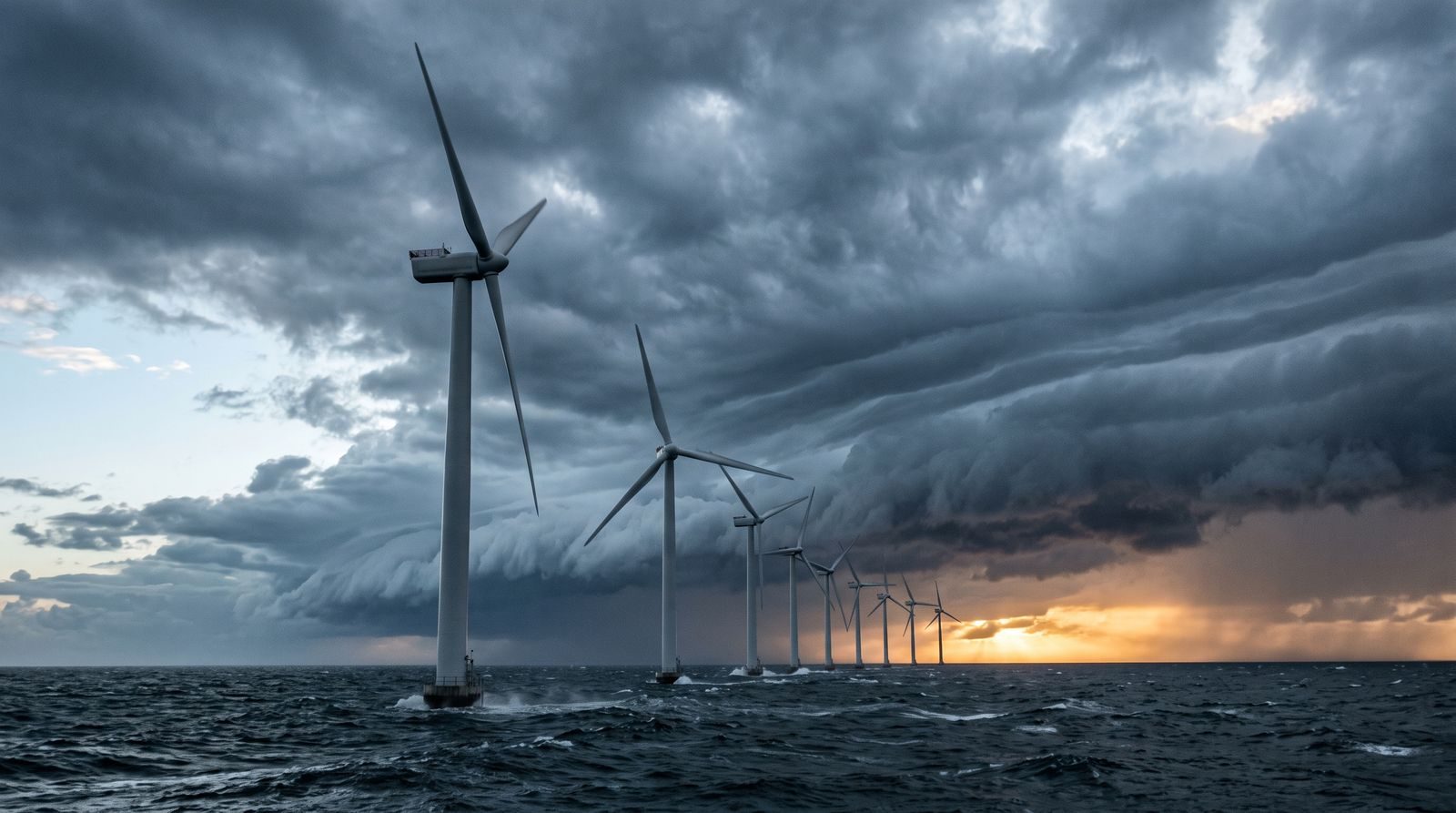
Then there is the detail that gives the game away. DeepMind researchers have been explicit that the model was engineered to predict wind speed at 100 metres above ground. Nobody checking whether to bring an umbrella cares about the wind at 100 metres. That is the hub height of a commercial wind turbine.
Six hours was a compute constraint, not a physics one
The six-hour assimilation cycle that governs traditional forecasting exists because ingesting global observations into a physics solver is enormously expensive. Everything downstream inherited that rhythm: grid operators, energy traders, airlines, insurers and logistics planners all built processes around a forecast that refreshes four times a day and is already stale when it lands.
A model that re-initialises hourly on live satellite feeds does not just produce a better forecast. It changes the shape of the decision. If your renewable generation forecast updates every hour rather than every six, the size of the reserve you have to hold, and therefore the cost of holding it, moves. That is the renewable-integration gap in one sentence: grids need to buy insurance against forecast error, and the price of that insurance is a direct function of how wrong the forecast is and how long you are stuck with it.
Our take: Read this as an inference-economics story, not a weather story. The 5km grid and the hourly cadence are only possible because a learned model is orders of magnitude cheaper to run than a physics solver at the same resolution — which means the constraint on forecast frequency has moved from supercomputer time to serving cost. Google shipped it into Search, Maps, Gemini, Maps Platform and Cloud on the same day. The consumer surfaces are distribution and a training-data flywheel. The revenue is in the API, and the buyers are utilities, renewables desks, reinsurers and anyone who moves physical goods on a schedule.
What this does to the incumbents
National meteorological agencies are not going away — they own the observation networks, and a learned model with no observations to learn from is a very expensive random number generator. But the commercial forecasting layer that sits on top of public agency output has been a business built on interpretation and packaging. When a free-at-the-edge, API-priced model outperforms the underlying agency product on precipitation and is tuned for turbine hub height, the packaging layer gets squeezed from above.
It also fits an increasingly obvious pattern. The most defensible AI products right now are not the chat interfaces; they are learned surrogates for expensive simulations — weather, protein folding, fluid dynamics, chip layout. The economics are the same every time: a simulation that cost a supercomputer run now costs an inference call, so you run it a hundred times more often, and the value shows up in the decisions that frequency unlocks rather than in the model itself.
What to watch
- API pricing. Whether Google prices WeatherNext through Cloud as a loss-leading commodity or as a premium industrial feed will tell you whether the target is the forecasting market or the cloud contract behind it.
- Verification against agency baselines. Accuracy claims from a model’s own developer need independent scoring. Watch for third-party verification on precipitation and 100m wind, not just headline skill scores.
- Utility procurement. The signal that this is a real business is a named grid operator or renewables trader putting it in the forecast stack, not a demo.
- Extreme-event behaviour. Learned models are trained on what has happened. The open question for every one of them is how they behave on the tail events that are the entire reason forecasting is funded.
The pitch is a sharper rain map. The product is a cheaper way to be less wrong about the next hour, sold to people for whom being wrong about the next hour is expensive.