AMD said Thursday afternoon it had reached a definitive agreement to acquire Taalas, a Toronto startup founded in 2023 that builds inference chips around a single AI model. Terms were not disclosed. The deal is subject to customary closing conditions and regulatory approvals; multiple outlets reported an expected close in the fourth quarter.
The technology is the story. A conventional GPU fetches model weights from memory billions of times a second, and that fetch — not the math — is what sets the speed ceiling on every inference system running today. Taalas removes the fetch by etching the weights directly into the metal layers of the die. The model stops being data the chip reads and becomes the circuit the chip is.
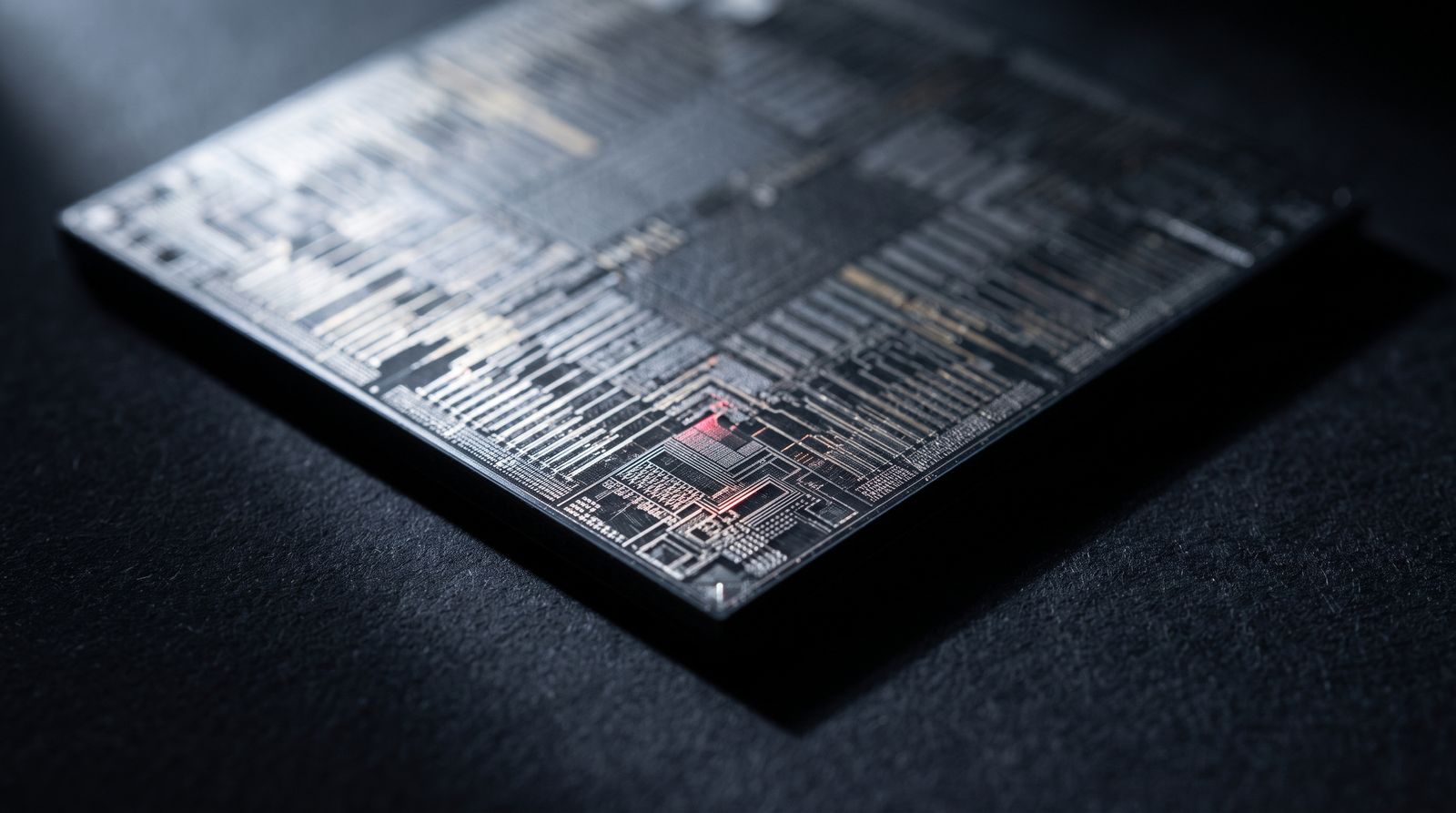
Taalas’ first public part, the HC1 technology demonstrator, is built on TSMC’s 6nm process: an 815-square-millimetre die carrying roughly 53 billion transistors in a 2.5-kilowatt server configuration. It runs Meta’s Llama 3.1 8B and, per benchmarks the company published, hits close to 17,000 tokens a second on it. Those are the vendor’s numbers, not an independent test. What is not in dispute is what the chip cannot do: run anything else. Ever.
What AMD said, and what it didn’t
Read the press release and you will not find the words etched, hardwired, or permanent. AMD’s language is that Taalas “optimizes inference dataflows, significantly reducing compute and memory bottlenecks associated with general-purpose architectures.” True, and carefully bloodless. The plan is to fold the technology into the accelerator roadmap and build system-level products alongside Instinct GPUs — which is the tell. This is a co-processor thesis, not a GPU replacement: the flexible silicon handles the long tail, the welded silicon handles the handful of models carrying real volume.
Vamsi Boppana, who runs AMD’s AI group, framed it as “flexibility to deploy the right compute solutions for every AI workload.” Buying the least flexible chip in the industry and selling it as flexibility takes some nerve, but the logic holds if you squint: flexibility at the rack level, rigidity at the die level.
Our take: The economics only work if a model stays valuable longer than it takes to tape out silicon for it — call it a year, plus fab time. For two years that was an obviously losing bet, which is why this remained startup territory. It stops being obviously losing the moment a small number of open-weight models become genuine infrastructure, running the same tokens over and over for years. AMD is not buying a chip here. It is buying a position on how fast the model layer stops moving. We covered Etched raising $300 million on the same premise; the difference is that a startup betting this can be wrong quietly, and an incumbent cannot.
Why the buyer matters more than the target
Taalas is AMD’s fourth inference deal since November, following inference-software firm MK1 and two smaller acquisitions. That pattern is the signal. Training is where the prestige and the headline capex sit, but it is a finite, lumpy market dominated by a handful of labs. Inference is the recurring bill — every query, forever — and it is the segment AMD has publicly argued will compound fastest. Nvidia’s moat is CUDA and generality, and generality is precisely what you stop paying for once your workload stops changing.
It also lands three days after AMD posted a quarter that beat on every line and sold off anyway, and while the company is still ramping Helios, the rack-scale system Anthropic signed up for 2 gigawatts of. AMD is assembling a stack, not shopping for a product.
What to watch
- Which model gets etched first. The chip is only as valuable as the durability of what is baked into it. An open-weight frontier model is a real bet; a Llama demo is a proof of concept.
- Whether performance claims survive contact with a third party. Vendor benchmarks on an 8B model are the easiest possible case. Independent numbers on something larger are the ones that count.
- Regulatory timing. A cross-border semiconductor acquisition into a fourth-quarter close is not automatic, and AMD leaned hard on the Canadian-jobs framing for a reason.
- Nvidia’s response. If model-specific silicon takes even a slice of high-volume inference, the pressure shows up in pricing long before it shows up in market share.
The uncomfortable version of this bet: a chip that runs one model perfectly is worthless the week that model is retired. AMD just decided that week is further away than it used to be.